Commercial Cleaning Contract Checklist New York: The 2026 Facility Manager’s Guide
According to the 2024 State of the Facility Management Industry report, 38% of New York facilities experienced at least one safety violation due to improper chemical storage or floor maintenance protocols. You know that maintaining a sterile, compliant environment is non-negotiable for operational uptime. By utilizing a technical commercial cleaning contract checklist New York professionals can mitigate these liability risks and ensure consistent quality across every square foot. When service execution lacks precision, your facility's productivity is the first thing to suffer.
We've engineered this guide to eliminate these operational gaps and restore technical authority to your maintenance strategy. You'll gain the tools to move beyond simple vendor transactions and establish a strategic partnership built on industrial reliability and clear accountability. This article outlines the essential service frequencies, measurable KPIs, and legal safeguards required to ensure your 2026 service level agreement delivers uninterrupted productivity and long-term facility health.
Key Takeaways
- Define a precise Scope of Work (SOW) to standardize high-touch disinfection and floor maintenance protocols for maximum facility reliability.
- Mitigate liability risks by verifying that vendor insurance certifications meet specific New York State mandates for general liability and workers' compensation.
- Implement a comprehensive commercial cleaning contract checklist New York to ensure every cleaning task aligns with your facility’s operational uptime requirements.
- Establish data-driven Key Performance Indicators (KPIs) to measure cleaning thoroughness and maintain consistent service quality across all shifts.
- Secure industrial continuity through formal inspection cadences and reporting structures that hold service providers accountable to rigorous technical standards.
Essential Scope of Work (SOW) Checklist for New York Facilities
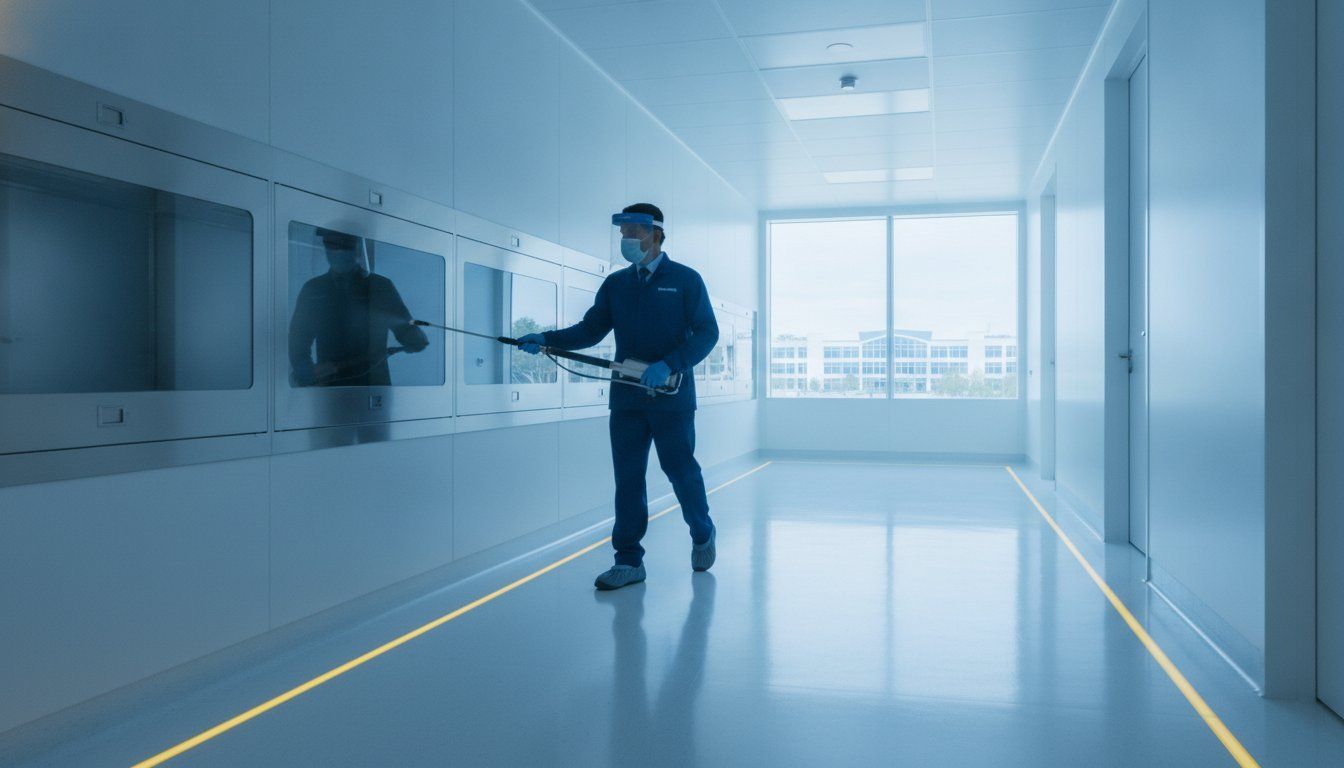
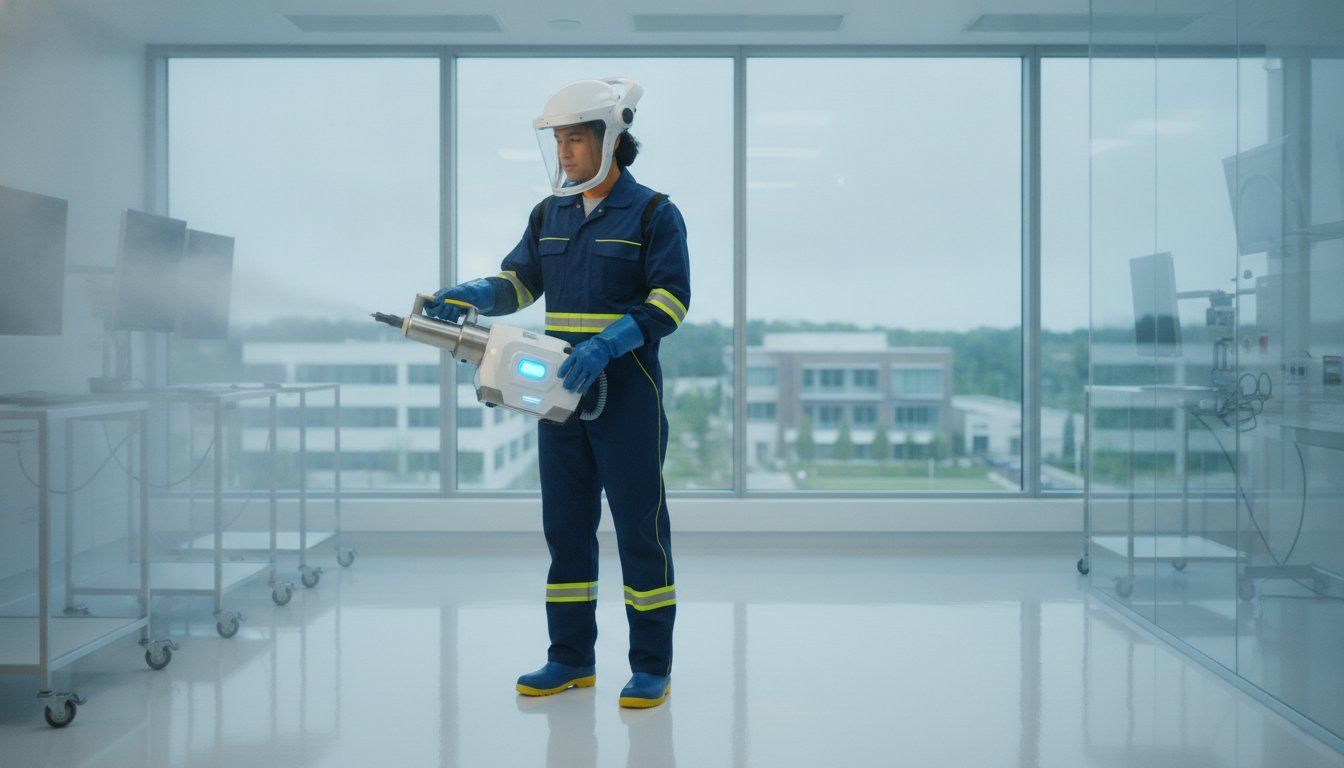
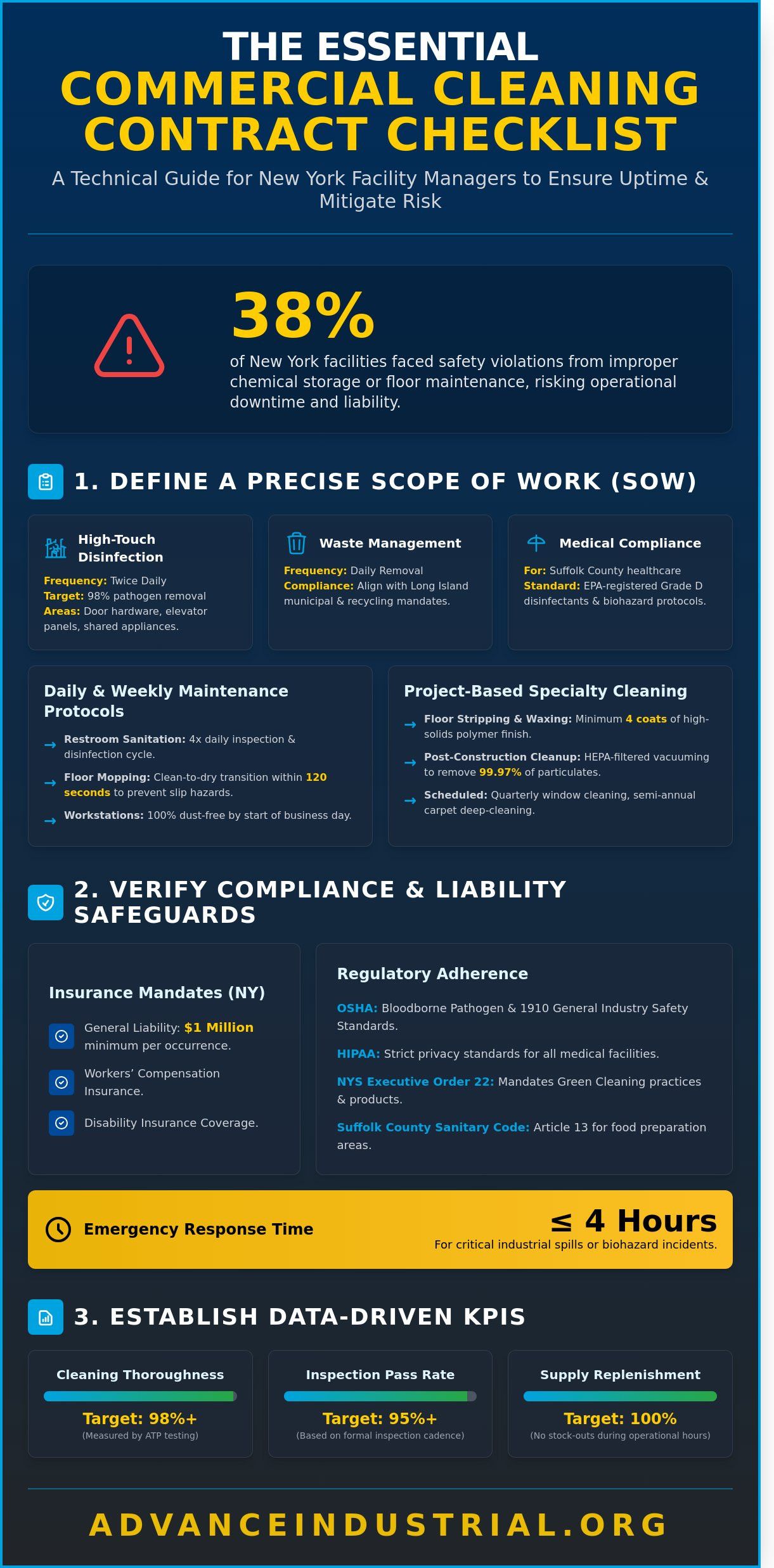
Establishing a precise Scope of Work (SOW) is the foundation of any effective commercial cleaning contract checklist New York facility managers utilize to maintain operational uptime. This document must define recurring janitorial tasks with technical accuracy to ensure uninterrupted productivity. High-touch surface disinfection, targeting 98% of pathogens on door hardware and elevator interfaces, should occur twice daily. Trash removal protocols must align with Long Island municipal waste schedules to prevent accumulation. For Suffolk County healthcare providers, the SOW must incorporate specialized medical cleaning standards, including ISO-compliant sanitation for clinical environments. These requirements are often codified within Service Level Agreements (SLAs) to ensure provider accountability and industrial excellence.
- High-touch disinfection: Twice daily targeting elevator panels, door hardware, and shared kitchen appliances.
- Waste management: Daily removal following local Long Island zoning laws and recycling mandates.
- Medical compliance: Suffolk County clinical spaces require EPA-registered Grade D disinfectants and biohazard handling protocols.
Daily and Weekly Maintenance Protocols
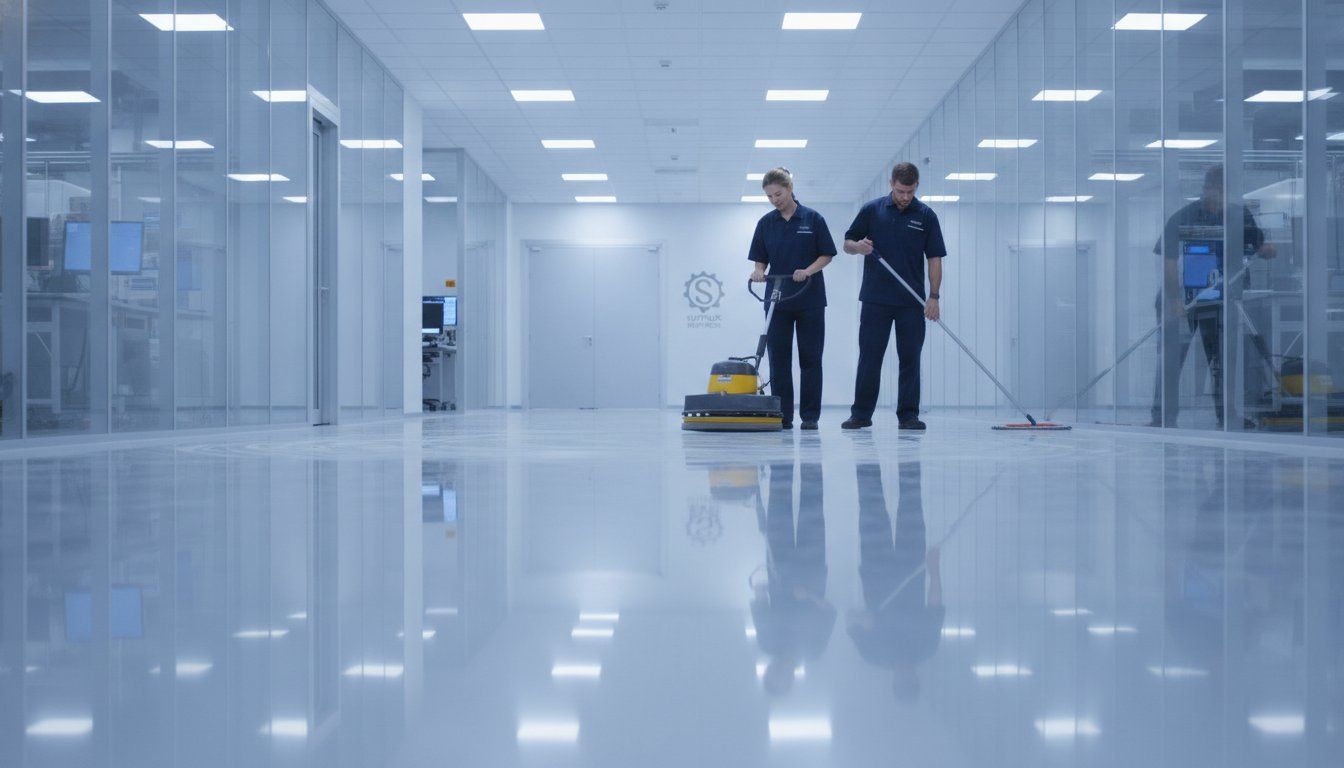
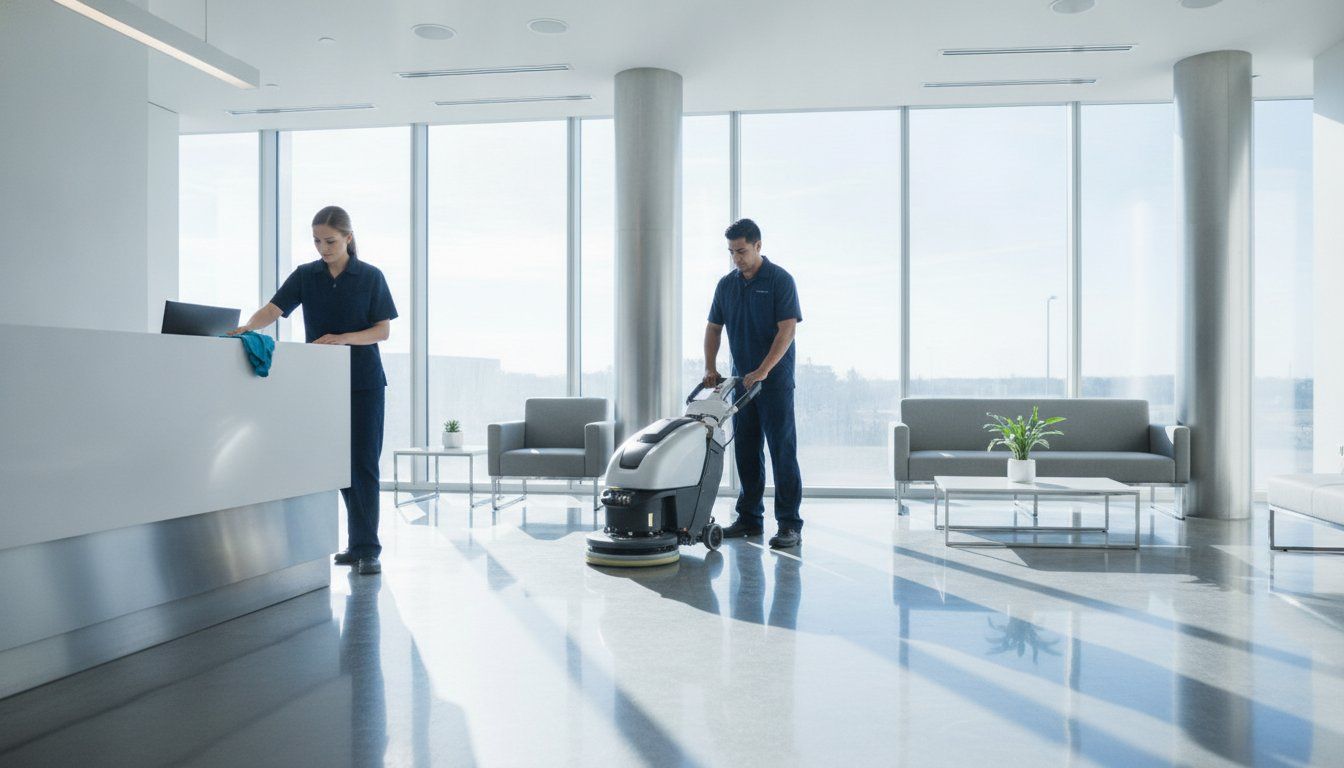
Reception areas and workstations require daily attention to maintain a professional atmosphere and ensure employee health. Restroom sanitation must include a 4x daily inspection cycle for supply replenishment and surface disinfection. This frequency prevents service gaps during peak operational hours in high-density office parks. Commercial floor mopping protocols require a clean-to-dry transition within 120 seconds to eliminate slip hazards and microbial growth. Effective protocols ensure that 100% of workstations are dust-free by the start of each business day.
Project-Based Specialty Cleaning Requirements
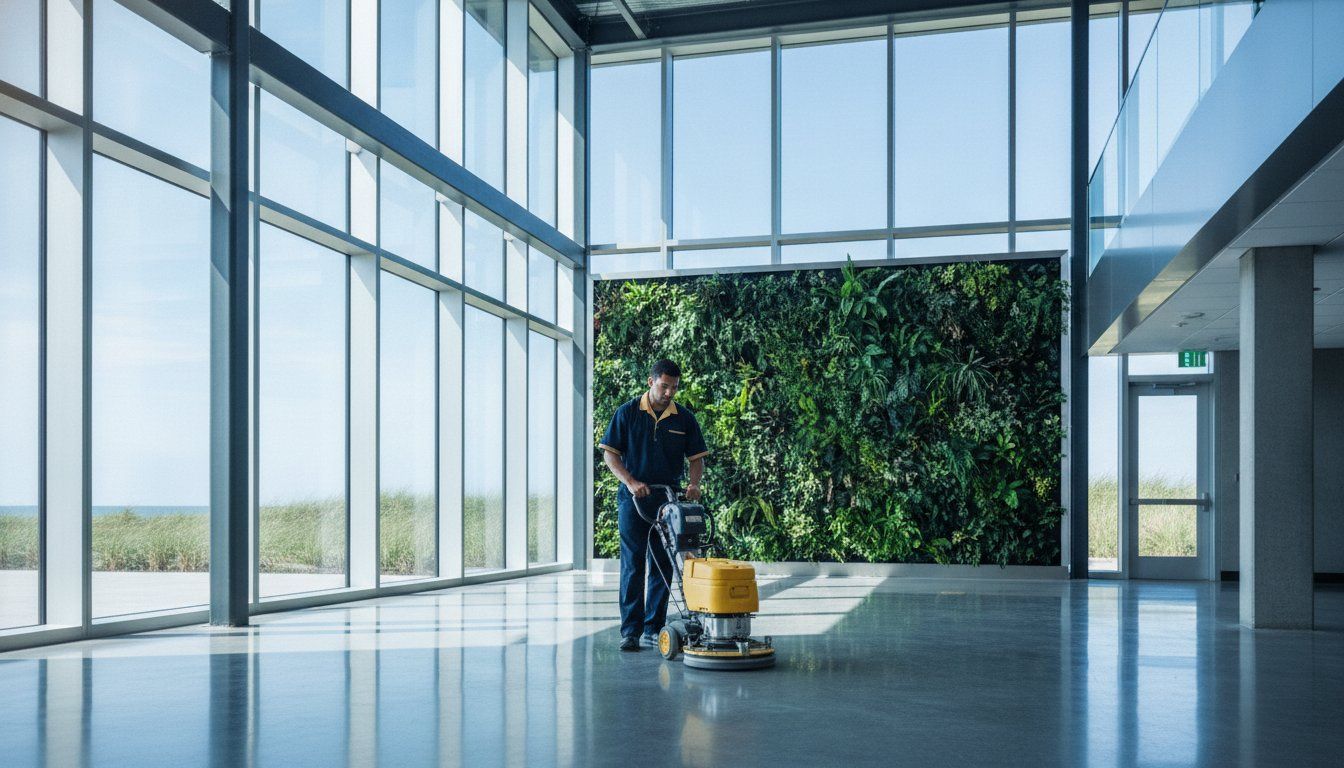
High-traffic Long Island office environments demand scheduled floor maintenance beyond daily mopping. Technical specifications for floor stripping and waxing must include the application of at least four coats of high-solids polymer finish to prevent liability from slip-and-fall incidents. For new commercial developments in Nassau County, post-construction cleanup milestones must include HEPA-filtered vacuuming of all surfaces to remove 99.97% of airborne particulates. Quarterly window cleaning and semi-annual carpet deep-cleaning using hot water extraction are essential for long-term asset preservation and maintaining the commercial cleaning contract checklist New York standards.
Before post-construction cleanup can even begin, the site itself must be properly prepared. For new commercial developments, this often involves extensive groundwork. Specialized providers like Advantage Outdoors Land Services handle the crucial first steps of land clearing and site preparation, setting the stage for a successful build and eventual maintenance.
Contractual Compliance and Liability Safeguards in New York
Effective risk management in facility maintenance starts with a rigorous commercial cleaning contract checklist New York professionals use to protect their physical and legal assets. You must verify that a vendor's Certificate of Insurance (COI) meets the state's minimum general liability requirements. These typically start at $1 million per occurrence for commercial properties in 2026. Contracts need explicit language covering Workers’ Compensation and Disability insurance as mandated by New York State law. This prevent third-party liability claims from impacting your bottom line during on-site accidents.
For specialized environments, compliance isn't optional. Medical facilities require strict adherence to HIPAA privacy standards and OSHA Bloodborne Pathogen protocols. Industrial sites must follow OSHA 1910 standards for general industry safety to ensure worker protection. When drafting these agreements, referencing the New York State Procurement Guidelines ensures your document aligns with established legal frameworks for service acquisition. Your contract should also define emergency response times. We recommend requiring a four-hour window for critical industrial spills or biohazard incidents to maintain operational continuity.
New York Regulatory and Insurance Standards
Facilities in Suffolk County must ensure cleaning protocols comply with local health department regulations. This specifically includes food preparation areas governed by Article 13 of the Suffolk County Sanitary Code. Additionally, New York State Executive Order 22 mandates Green Cleaning practices for various facilities, requiring the use of environmentally sensitive products. Implementing these standards reduces chemical exposure for your staff and maintains regional environmental compliance. You can track these regulatory updates through a technical resource feed to stay ahead of shifting state mandates.
Safety and Staffing Professionalism
Facility security depends on the integrity of external personnel. Every contract should mandate comprehensive background checks and clear uniform requirements for all staff members entering the premises. This ensures that only authorized, identifiable individuals access sensitive areas. We recommend requiring the use of EPA-approved disinfectants from List N to ensure efficacy against emerging pathogens. Relying on advanced equipment and standardized protocols preserves your facility's long-term durability. These safeguards transform a simple service agreement into a robust framework for industrial excellence.
Performance Metrics and Long Island Service Level Agreements (SLAs)
A rigorous commercial cleaning contract checklist New York operations require must focus on measurable data. We define success through technical Key Performance Indicators (KPIs) rather than subjective visual checks. Effective contracts specify a 98% compliance rate on high-touch surface sanitation and 100% adherence to scheduled MRO supply restocking. Facility managers should establish a formal inspection cadence every 14 days to review these metrics and ensure technical standards are met.
Transparency is maintained through a "Right to Cure" clause. This provision gives vendors 24 hours to resolve specific service failures before any contractual penalties apply. It's a pragmatic approach that maintains operational uptime while holding the partner accountable. Billing should clearly separate recurring monthly maintenance fees from project-based specialty services, such as semi-annual floor resurfacing or industrial degreasing, to prevent budget creep.
Establishing Strategic Partnerships Through Transparency
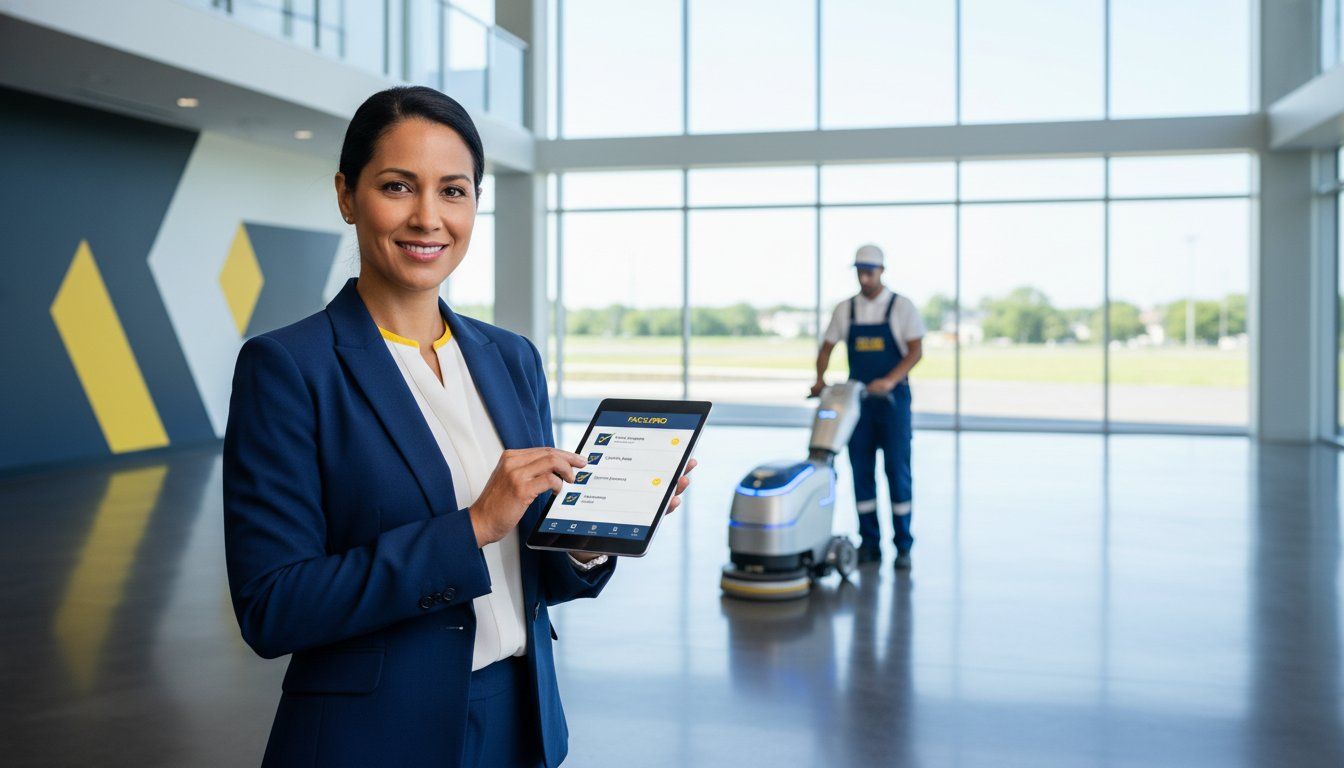
Digital reporting tools are essential for tracking cleaning milestones in real time. These systems provide the technical authority needed to confirm uninterrupted productivity across the plant floor. By utilizing a single-source provider, you consolidate your integrated supply chain and reduce the friction of managing multiple maintenance contacts. This strategic partnership ensures that facility standards remain consistent, reliable, and engineered for long-term durability.
Finalizing the Contract for Industrial Excellence
The final walkthrough in Bohemia and neighboring Long Island districts serves as the definitive verification of service quality. Use a detailed 50-point checklist to audit every zone, from the loading docks to the executive offices, before signing the agreement. This final audit ensures the commercial cleaning contract checklist New York industrial sites depend on is fully realized. To maintain these high standards over time, facility leaders should stay updated on industrial maintenance trends to adapt to evolving safety and efficiency requirements.
Securing Operational Continuity for 2026 and Beyond
Managing a high-traffic facility in 2026 requires more than a basic service agreement. It demands a rigorous Scope of Work and a commercial cleaning contract checklist New York facility managers can rely on to mitigate risk. Precision in your Service Level Agreements ensures that performance metrics remain transparent while protecting your infrastructure from liability gaps. Commercial Cleaning Services Advance Industrial Maintenance provides the technical authority needed to maintain these standards across Long Island. We focus on the specific details that prevent downtime and ensure your site meets every regulatory benchmark.
Based in Bohemia, NY, we operate as a privately owned partner with over 40 years of industrial experience. Our teams specialize in medical facility maintenance, providing HIPAA-compliant cleaning protocols that satisfy the most rigorous audit requirements. We understand that operational uptime depends on consistent, engineered cleaning solutions rather than generic janitorial services. Don't settle for a vendor when you can secure a strategic partnership built on four decades of reliability. Our expertise ensures your facility remains a productive, safe environment for every occupant.
Request a Professional Facility Audit and Contract Proposal to align your 2026 operations with industrial excellence. We look forward to optimizing your facility's performance and supporting your long-term success.
Frequently Asked Questions
What insurance coverage is required for commercial cleaning companies in New York?
Commercial cleaning providers in New York must carry General Liability insurance with limits of at least $1 million per occurrence and $2 million aggregate. This coverage protects against property damage and third-party injuries. New York State law also requires Workers' Compensation and Disability insurance for all employees. When reviewing a commercial cleaning contract checklist New York, verify that the vendor holds an Umbrella policy of $5 million or more. If they don't, your facility remains exposed.
How often should a Long Island office schedule floor stripping and waxing?
Long Island office facilities should schedule floor stripping and waxing every 6 to 12 months based on foot traffic volume. High-traffic entryways and corridors often require service twice per year to prevent substrate degradation. Low-traffic administrative zones can extend this interval to 18 months. Maintaining this schedule prevents the 15% increase in floor replacement costs that occurs when finish layers wear down. It's a necessary investment for protecting your facility's physical assets.
What is the difference between janitorial services and commercial deep cleaning?
Janitorial services cover daily maintenance tasks like trash removal, restroom sanitation, and surface dusting to maintain baseline hygiene. Commercial deep cleaning is a technical process involving 100% surface disinfection and high-level HEPA filtration for HVAC vents. While janitorial work occurs 5 to 7 times per week, deep cleaning is typically performed quarterly. It's a critical component of a comprehensive commercial cleaning contract checklist New York for industrial facility managers who prioritize operational uptime.
Can a cleaning contract include emergency response for facility issues in Suffolk County?
Cleaning contracts for Suffolk County facilities can include 24/7 emergency response clauses for flooding, biohazard spills, or post-storm cleanup. These agreements specify a guaranteed response time, often 2 to 4 hours from the initial service request. Including these terms ensures that industrial operations resume within 24 hours of an incident. It's a strategic partnership approach that minimizes downtime and protects expensive capital equipment from environmental damage during unforeseen events.