Infection Control Cleaning Services: Technical Standards for Long Island Facilities (2026)
What if the primary threat to your facility's operational continuity isn't a mechanical failure, but a microscopic one that standard janitorial methods simply cannot touch? For many Long Island facility managers, the gap between looking clean and being clinically sterile is where healthcare-associated infections (HAIs) and regulatory fines thrive. You likely recognize that inconsistent results from low-cost vendors and the complexity of evolving CDC standards create a high-stakes environment for your staff and patients. This article outlines how to implement professional infection control cleaning services that move beyond surface-level aesthetics to ensure rigorous regulatory compliance. We will examine the technical standards required for 2026, including methodical biofilm removal and the transition from basic sanitation to a documented, engineering-focused cleaning protocol that secures your facility's long-term stability.
Key Takeaways
- Establish a risk-based cleaning framework by distinguishing between high-touch surfaces and low-risk zones to optimize facility resource allocation.
- Implement a multi-step protocol for infection control cleaning services that prioritizes mechanical biofilm removal to ensure chemical disinfectants reach target pathogens.
- Align your facility operations with 2026 New York State health mandates and AORN standards to mitigate liability and prevent critical cleaning failures.
- Utilize local technical expertise in Nassau and Suffolk Counties to develop documented sanitation programs that support uninterrupted operational continuity and patient safety.
Table of Contents
Defining Infection Control Standards for High-Stakes Environments
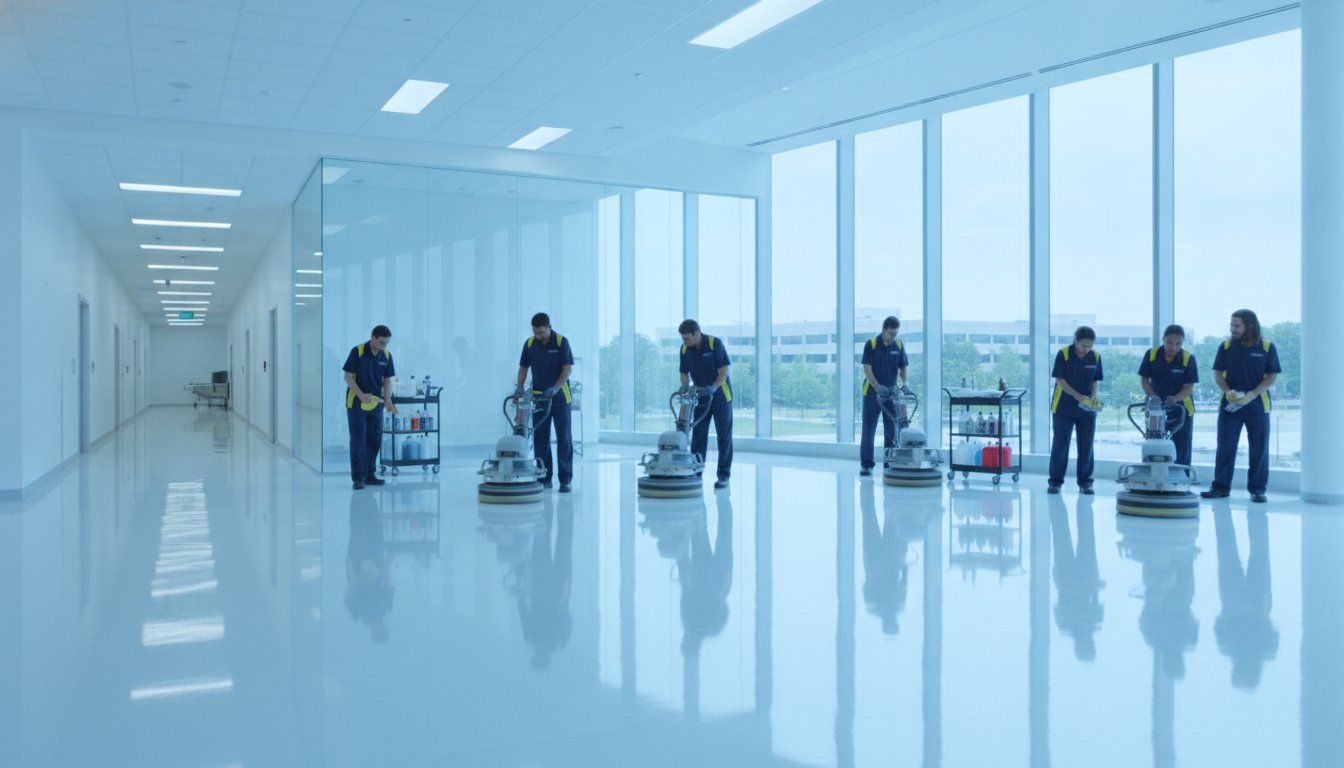
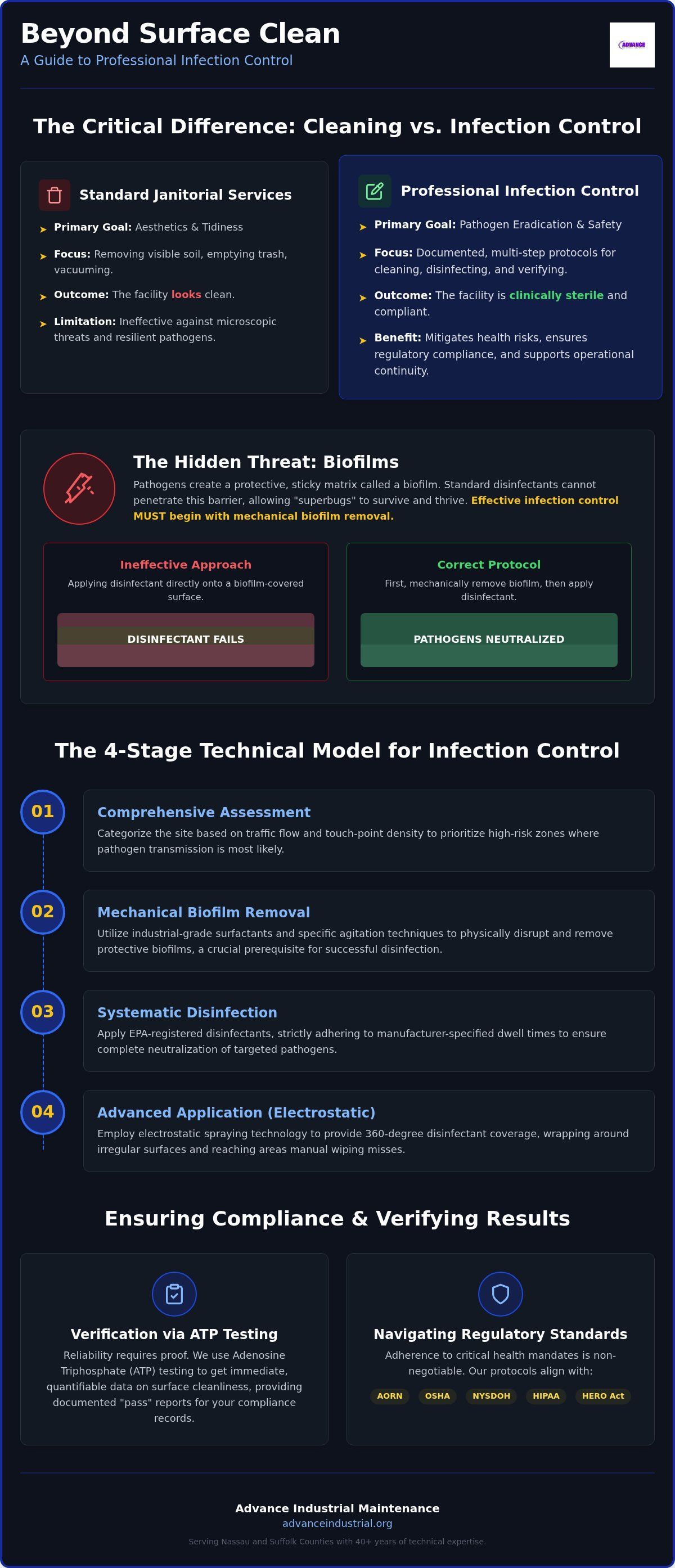
Standard janitorial tasks focus on aesthetics, such as emptying trash or vacuuming carpets. In contrast, professional infection control cleaning services operate on a technical plane where the primary objective is pathogen eradication. This process requires a rigorous, multi-step protocol that includes:
- Cleaning: The mechanical removal of visible soil and organic matter.
- Disinfecting: The application of EPA-registered chemicals to kill specific microorganisms.
- Verifying: The use of testing or documented inspection to confirm the protocol's success.
Adhering to established infection prevention and control standards transforms sanitation from a routine maintenance expense into a core strategy for operational continuity. When you reduce the transmission of pathogens, you directly lower staff absenteeism and protect patient safety. A risk-based approach is essential here. It involves identifying high-touch surfaces, such as door handles and medical interfaces, which require high-frequency disinfection, while allocating standard resources to low-risk zones like administrative storage.
The Role of Biofilms in Pathogen Persistence
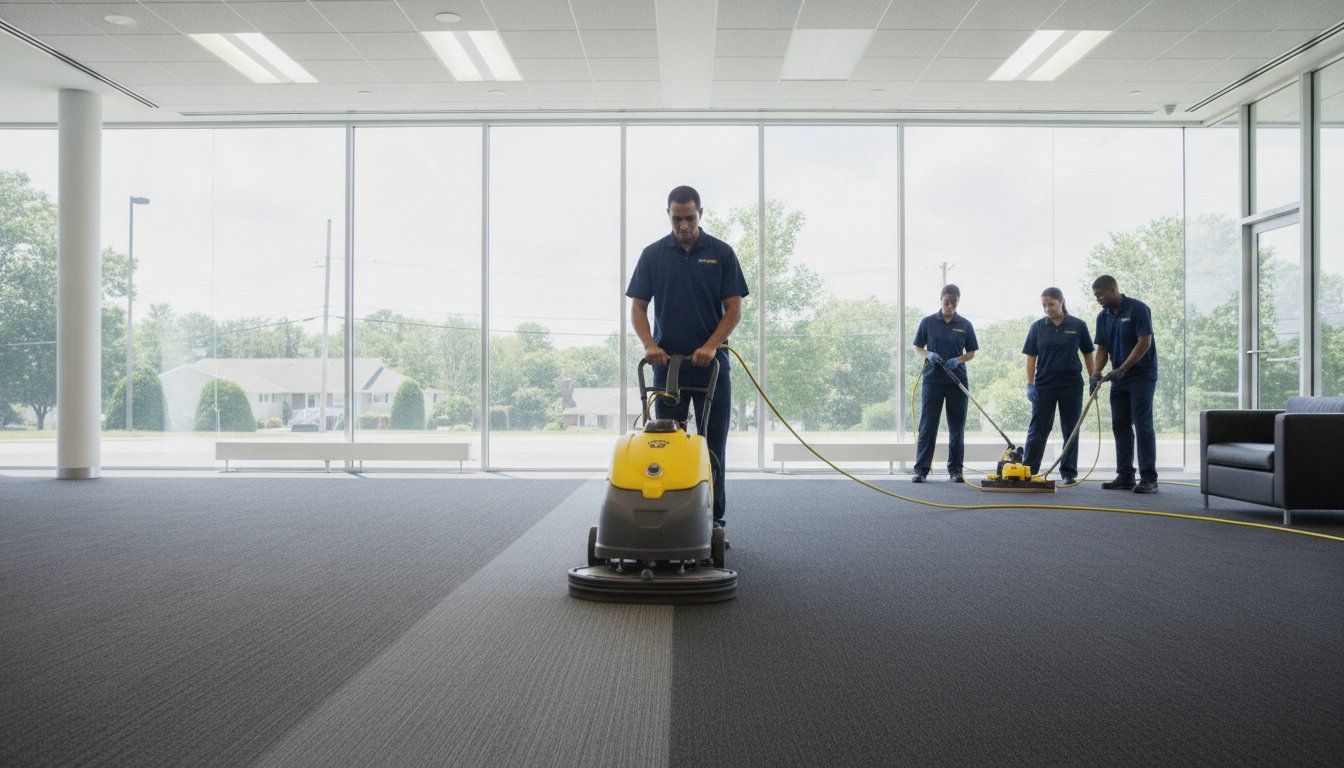
Microorganisms don't simply sit on surfaces; they often create protective biofilms. These are complex, sticky matrices that shield bacteria from standard disinfectants. If a vendor applies chemicals without first performing mechanical cleaning, the disinfectant likely won't penetrate this barrier. This persistence is a major challenge in shared commercial spaces where "superbugs" can survive for extended periods. Breaking these barriers requires industrial-grade surfactants and specific mechanical agitation. By prioritizing the physical removal of biofilms, your facility ensures that subsequent disinfection steps are actually effective against the most resilient pathogens.
Advanced Disinfection Protocols: From Biofilm Removal to Verification
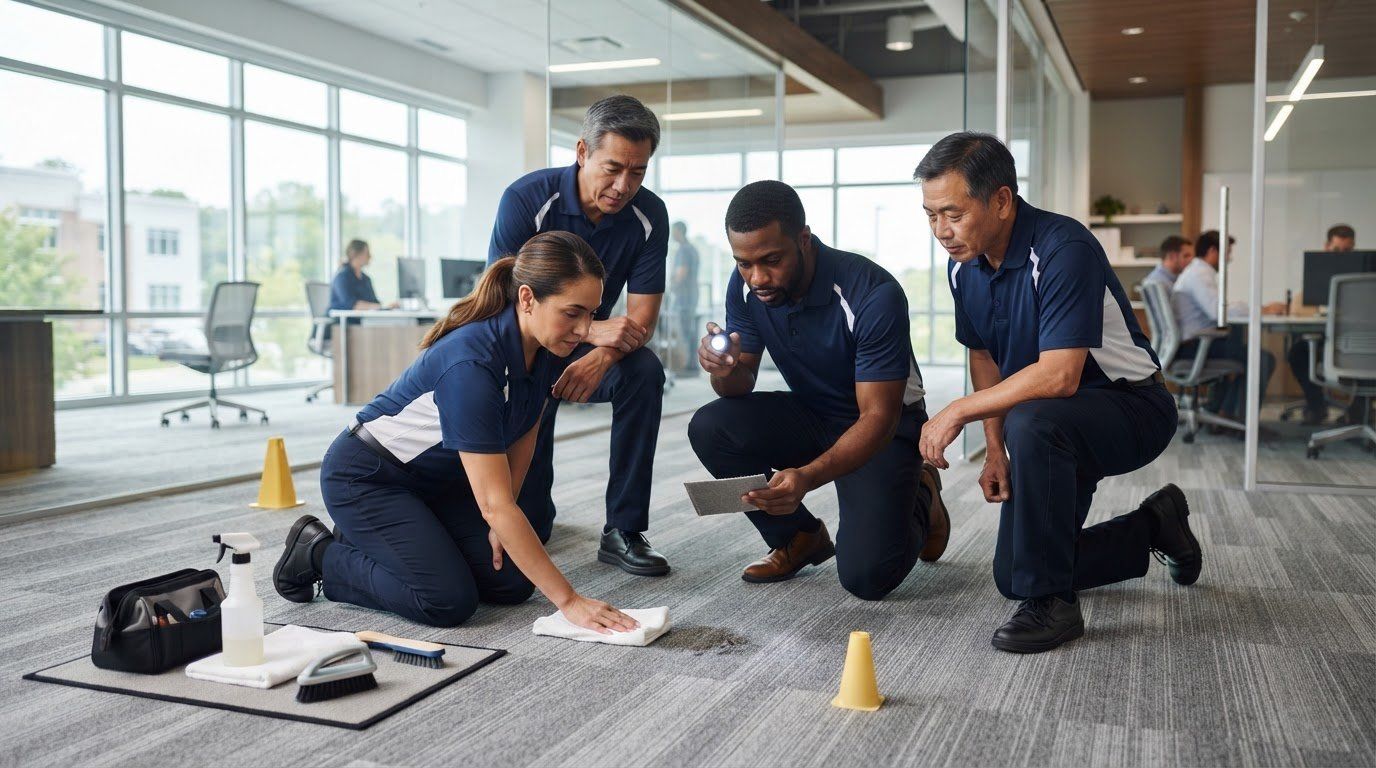
Effective execution of infection control cleaning services relies on a disciplined, four-stage technical model. We start with a comprehensive visual assessment to categorize the site according to traffic flow and touch-point density. This allows our team to prioritize high-risk zones where pathogen transmission is most likely. The second stage involves the mechanical removal of organic matter. We use industrial-grade surfactants to physically disrupt biofilms, which is a necessary prerequisite for successful chemical disinfection.
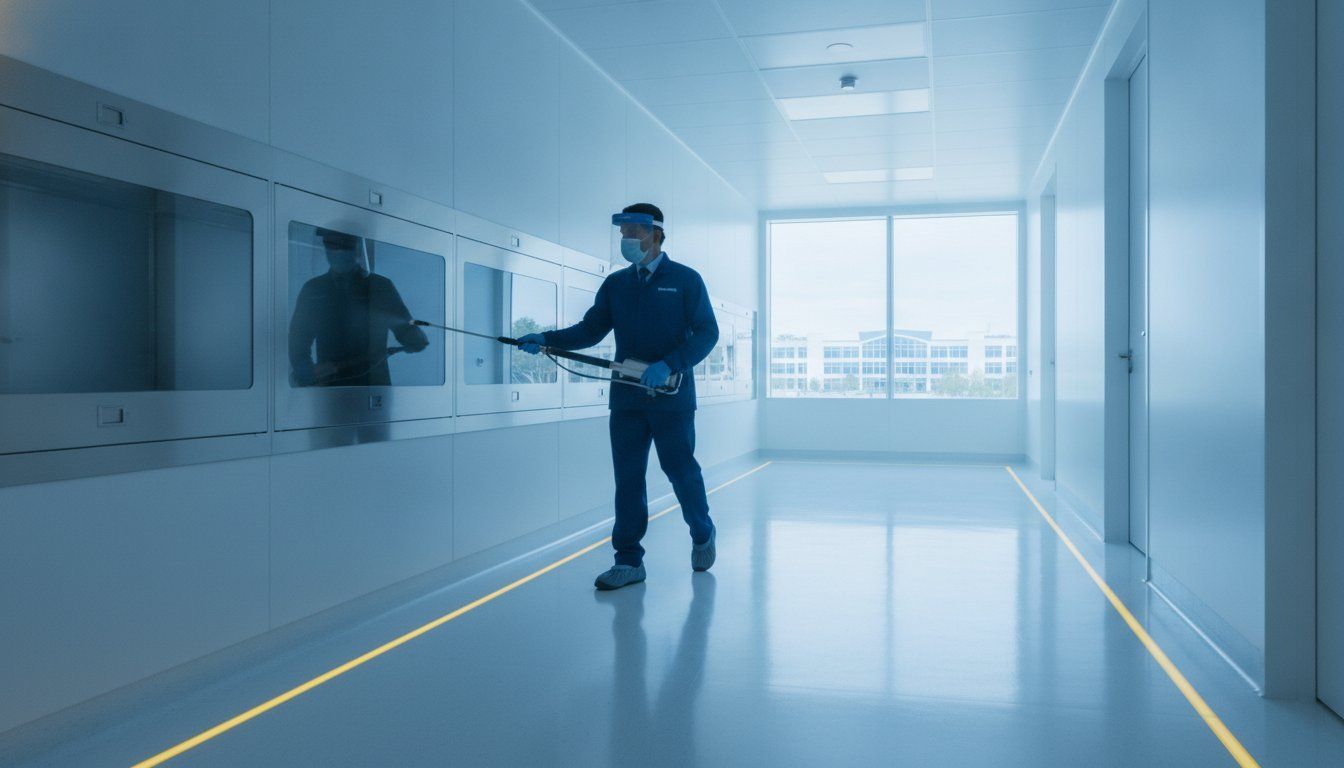
The third stage is the systematic application of EPA-registered disinfectants as part of our infection control cleaning services. Our technicians strictly adhere to manufacturer-specified dwell times to ensure total neutralization of targeted pathogens. In complex medical or industrial environments, we utilize electrostatic spraying for the fourth stage. This equipment provides 360-degree coverage by wrapping disinfectant around irregular surfaces and reaching shadowed areas that manual wiping often misses. It's a methodical approach that aligns with OSHA infection control protocols to protect your workforce from health risks and your business from penalties that can reach $16,550 per citation.
Verification via ATP Testing and Quality Assurance
Reliability in sanitation requires objective proof rather than subjective visual checks. We utilize Adenosine Triphosphate (ATP) testing to provide immediate, quantifiable data on surface cleanliness. By measuring bioluminescence, our team produces documented "pass" reports that give facility managers a clear record of compliance. This technical verification is central to how Commercial Cleaning Services Advance Industrial Maintenance operates. With 40 years of experience serving Nassau and Suffolk Counties, we provide the precision engineering needed for consistent results. Our Bohemia-based specialists act as a knowledgeable extension of your team, ensuring your medical facility cleaning program meets the highest industrial standards.
Implementing a Compliant Program in Nassau and Suffolk Counties
Implementing a compliant program requires navigating New York State mandates, including the requirement for EPA and DEC-registered disinfectants. For medical facilities, this means adhering to NYSDOH regulations and the HERO Act's airborne infectious disease prevention plans. HIPAA compliance is equally critical. Our specialized medical facility cleaning protocols ensure technicians handle environments containing sensitive patient information with the necessary discretion and technical precision. It's a level of care that standard janitorial vendors often overlook, putting your facility at risk for both health and legal liabilities.
Selecting a local partner in Bohemia provides geographic advantages for Nassau and Suffolk facilities. Rapid emergency response is a core component of operational stability. Unlike national franchises, the 40-year legacy of Commercial Cleaning Services Advance Industrial Maintenance provides a deep understanding of Long Island's specific regulatory and industrial environment. We function as an extension of your team, providing the technical authority needed to manage infection control cleaning services across diverse commercial footprints. This local presence ensures that your facility isn't just another number in a national database but a priority in our shared community.
Strategic Alliances for Long-Term Facility Stability
We view the role of Commercial Cleaning Services Advance Industrial Maintenance as a high-level collaborative alliance rather than a simple vendor transaction. This relationship integrates recurring janitorial services with targeted deep-disinfection projects to address the high stakes of healthcare sanitation. This hybrid model ensures that daily maintenance supports long-term technical standards, preventing the accumulation of biofilms and reducing the risk of HAI outbreaks. Managers can maintain this standard by following industry updates to adjust protocols as new pathogens or regulations emerge. This proactive coordination minimizes downtime and ensures your facility remains a safe, compliant environment for both staff and patients.
Securing Your Facility's Operational Future
Transitioning from standard janitorial maintenance to a technical engineering framework is the only way to ensure 2026 regulatory compliance and operational stability. By implementing the risk-based protocols and ATP verification methods discussed, your facility can effectively neutralize the threat of persistent biofilms and "superbugs." Maintaining this level of precision requires more than a vendor; it necessitates a partner that understands the high stakes of medical and commercial sanitation. Since 1984, Commercial Cleaning Services Advance Industrial Maintenance has provided specialized infection control cleaning services across Nassau and Suffolk Counties. Our 40-year legacy in Bohemia serves as a cornerstone for local facilities that prioritize dependability and technical authority. Don't leave your facility's safety to chance. Request a Technical Consultation for Your Facility today to integrate our specialized expertise into your team. We're committed to the long-term success of your operation.
Frequently Asked Questions
What is the difference between cleaning and disinfecting?
Cleaning is the mechanical removal of soil and organic matter, while disinfecting is the chemical process of killing pathogens. You can't effectively disinfect a surface that hasn't been cleaned first because biofilms shield microorganisms from chemical agents. Our infection control cleaning services prioritize this two-step approach to ensure that disinfectants reach and neutralize the targeted bacteria.
How often should a medical facility in Long Island undergo deep infection control cleaning?
Frequency depends on your facility's specific risk profile and traffic volume. High-traffic medical environments typically require daily disinfection of high-touch zones, supplemented by monthly or quarterly deep cleaning projects. Following AORN 2026 guidelines and NYSDOH regulations ensures your schedule maintains operational continuity. We work as an extension of your team to establish a documented cadence that meets these rigorous technical standards.
Are the disinfectants used safe for electronic medical equipment?
Disinfectants are safe for electronics when applied using specialized methods like electrostatic spraying or low-moisture wipes. These techniques provide comprehensive coverage without the risk of liquid damage to sensitive medical interfaces. Our protocols prioritize material compatibility, ensuring that your mechanical systems and high-value equipment remain functional while achieving the necessary level of pathogen eradication for facility safety.
How does ATP testing verify that a surface is actually sterile?
ATP testing measures Adenosine Triphosphate, the energy molecule in organic matter, to provide immediate data on surface cleanliness. It doesn't prove absolute sterility in a surgical sense, but it verifies that organic residues have been removed. By measuring bioluminescence, we provide facility managers with documented proof that their infection control cleaning services have successfully reduced microbial loads to safe, industrial-grade levels.