Managing Your Cleaning Budget: A 2026 Practical Guide

What if the best way to control cleaning costs isn’t to reduce service, but to define it more clearly? Budget pressure is real, and cutting frequency can seem like a quick fix. But unclear proposals are difficult to compare, while reducing work in high-use areas can undermine facility standards. Managing your cleaning budget effectively starts with matching tasks and frequency to each space, then planning for work that can disrupt a forecast, such as unplanned deep cleaning.
This guide explains how to build a practical budget, compare in-house staffing with contractor options, and monitor spending without losing sight of service quality. You’ll learn how to define the scope, prioritize cleaning across your facility, and review costs as needs change.
Key Takeaways
- Managing your cleaning budget effectively starts with mapping facility zones, usage patterns, and required tasks before changing service levels.
- Separate routine janitorial work from periodic projects to make forecasts more useful and account for less predictable needs.
- Compare in-house, contracted, and blended approaches against the same scope, including labor, supplies, exclusions, and change requests.
- Track planned and actual spending alongside completed tasks and quality concerns, then review the service scope as facility needs change.
Table of Contents
Managing Your Cleaning Budget Effectively: Start with a Baseline
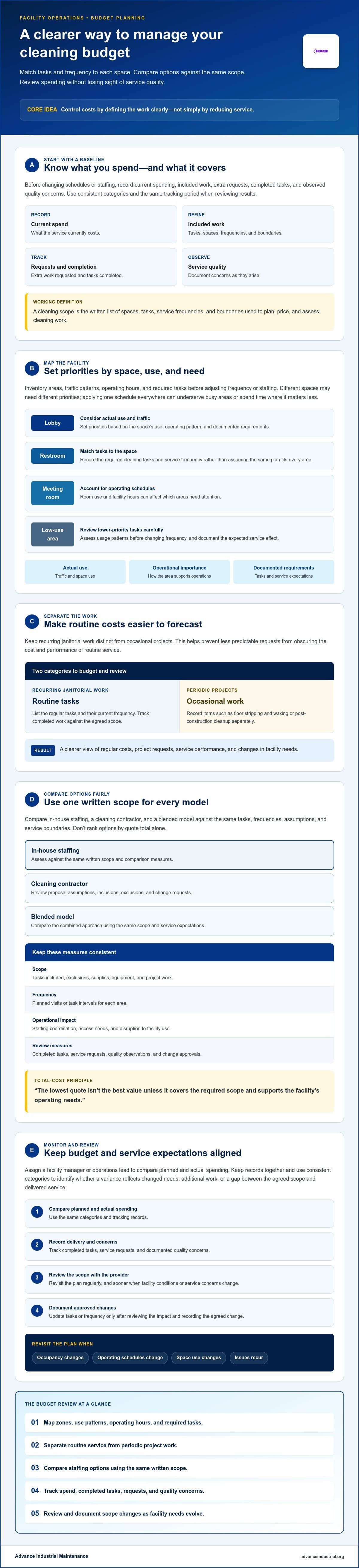
Before changing the schedule, record what you spend, what work is included, and where extra requests or quality concerns arise. This gives you a reference point for comparing future costs and deciding whether a change is improving value or simply reducing service.
Start Managing Your Cleaning Budget by Defining Facility Needs
Before adjusting frequency or staffing, document what needs cleaning and how those needs vary by space. Inventory areas, traffic patterns, operating hours, and required tasks. A lobby, restroom, meeting room, and low-use storage area may need different priorities. Applying one schedule everywhere can leave busy areas underserved or spend time where it matters less. This assessment is part of facility management, where service planning supports reliable building operations.
Separate recurring janitorial work from periodic projects. List routine tasks and their current frequency, then record occasional work such as floor stripping and waxing or post-construction cleanup separately. This distinction makes regular costs easier to forecast and keeps project requests from obscuring the cost and performance of routine service.
Establish a baseline that includes current spending, service frequency, extra requests, completed work, and observed quality concerns. Use the same tracking period and categories when reviewing results. A useful scope definition is: A cleaning scope is the written list of spaces, tasks, service frequencies, and boundaries used to plan, price, and assess cleaning work.
How should Long Island facilities set cleaning priorities?
Rank spaces by actual use, operational importance, and documented cleaning requirements. For a Nassau or Suffolk County facility, base the plan on its layout, traffic, and operating schedule, not assumptions about local businesses. Identify tasks that may need specialist attention and confirm the required service scope before budgeting for them. For specialized concerns such as moisture intrusion or mold, reviewing protocols from restoration professionals like Coastline Environmental Solutions, Inc. can help facility teams understand project boundaries and avoid costly oversights. Clear priorities help managers adjust frequency while maintaining attention to important areas.
Compare Cleaning Budget Options by Scope, Labor, and Total Cost
Compare in-house staffing, a cleaning contractor, and a blended model against the same written tasks, frequencies, assumptions, and service boundaries. Review labor hours, who supplies equipment and materials, how periodic project work is handled, what’s excluded, and how changes are requested. ISSA’s guide to calculating commercial cleaning rates can help frame the cost factors in a proposal. Don’t rank options by quote total alone.
Comparison measure | What to record
Scope | Tasks included, exclusions, supplies, equipment, and project work
Frequency | Planned visits or task intervals for each area
Operational impact | Staffing coordination, access needs, and disruption to facility use
Review measures | Completed tasks, service requests, quality observations, and change approvals
Total-cost principle: “The lowest quote isn’t the best value unless it covers the required scope and supports the facility’s operating needs.” Use consistent assumptions to make differences visible and support informed decisions while managing your cleaning budget effectively. When pricing periodic project work like exterior surface or driveway maintenance, property managers can discover Ehrman's Power Wash to see how professional service scopes and expectations are outlined.
How can you reduce spend without cutting essential cleaning?
Review usage patterns before changing the frequency of lower-priority tasks. Keep high-use and business-critical areas in the comparison, and document the expected service effect of each proposed adjustment. Bundling related services or improving task efficiency may be worth assessing, but neither guarantees a lower total cost. For Long Island facilities, Advance Industrial Maintenance provides office cleaning and janitorial services that can be considered when reviewing commercial cleaning needs and scope.
Put Your Cleaning Budget into Practice with a Long Island Service Review
A budget becomes useful when someone owns the review. Assign a facility manager or operations lead to compare planned and actual spending and record completed tasks, service requests, and documented quality concerns. Keep the records together and use consistent categories. This helps show whether a variance reflects changed facility needs, additional work, or a gap between the agreed scope and the service delivered.
Schedule regular scope reviews with the cleaning provider, and revisit the plan sooner when occupancy, operating schedules, space use, or recurring issues change. For a Long Island office, a change in how rooms are used may affect which areas need attention, even if the overall footprint stays the same. Review the impact before revising tasks or frequency, then document approved changes so the budget and service expectations stay aligned.
When should a facility manager revisit the cleaning plan?
Review it when operating conditions change or service concerns recur. Use your records to diagnose the issue before changing the budget: repeated missed tasks may point to execution, unclear responsibilities may indicate a communication problem, and a mismatch between the schedule and building use may call for a scope or scheduling adjustment. This evidence-based cycle supports managing your cleaning budget effectively without treating every concern as a reason to cut service.
For offices in Nassau or Suffolk County, discuss facility requirements and service scope with a local commercial cleaning company. Advance Industrial Maintenance serves commercial clients across Long Island. Learn about commercial cleaning for your Long Island facility.
Build a Cleaning Budget You Can Adjust with Confidence
A dependable cleaning budget starts with a clear picture of facility needs, then compares staffing and contractor options against the same documented scope. Track planned and actual spending alongside completed work and service concerns, so reviews lead to informed adjustments rather than reactive cuts. This repeatable approach supports managing your cleaning budget effectively while keeping service aligned with facility standards.
For Long Island businesses, Advance Industrial Maintenance serves commercial clients in Nassau and Suffolk Counties and brings over 40 years of experience. The company offers office cleaning, janitorial services, floor maintenance, and specialized deep cleaning. Discuss your facility’s requirements and service scope with the team. Contact Advance Industrial Maintenance about your commercial cleaning needs.
Frequently Asked Questions
How can I manage a commercial cleaning budget effectively?
Manage a commercial cleaning budget effectively by matching the written service scope to how each area is used, then tracking spending and service results. Record task frequency, completed work, extra requests, and quality concerns. For a Long Island facility, use its actual layout and operating schedule to set priorities. Review the records before changing frequency so budget adjustments don’t compromise important areas.
Is it cheaper to hire an in-house cleaning team or a commercial cleaning company?
Neither option is automatically cheaper; compare the full scope and operating requirements. For in-house staffing, account for labor hours, supervision, supplies, equipment, and scheduling responsibilities. For a cleaning company, review included tasks, frequencies, supplies, exclusions, project work, and how service changes are handled. Compare both against the same assumptions, then assess whether each option can reliably meet your facility’s needs.
How often should a business review its cleaning budget?
Track planned and actual spending regularly, and schedule scope reviews at a cadence your operation can sustain. Revisit the budget when occupancy, operating hours, space use, or recurring service issues change. For businesses in Nassau and Suffolk Counties, local service needs still depend on each facility’s specific operations. Documenting results helps determine whether to adjust scope, scheduling, communication, or execution.
What should I compare when reviewing commercial cleaning quotes?
Compare quotes against the same written tasks, frequencies, assumptions, and service boundaries. Check labor hours, included supplies or equipment, project work, exclusions, and the process for requesting changes. Also consider operational impact and how completed tasks and service quality will be reviewed. A lower quote may leave important work out, so assess coverage and fit, not just the total.