Eco-Friendly Cleanup: 3 Major Myths Debunked for Long Island Commercial Facilities

For facility managers across Nassau and Suffolk Counties, the assumption that high-performance sanitation requires harsh chemical profiles is an outdated operational liability. A 2023 assessment of New York State environmental standards confirms that stricter VOC limits are now a mandatory baseline for commercial compliance, not an optional upgrade. You likely recognize the pressure to maintain a sterile environment while managing the rising costs of MRO supplies and navigating complex state mandates. It's a difficult balance when your facility's operational uptime depends on consistent, repeatable results.
Transitioning to a strategic eco-friendly cleanup protocol is no longer a compromise on efficacy. It's a calculated move to improve indoor air quality and secure a competitive advantage in the local market. By integrating sustainable maintenance into your supply chain, you satisfy rigorous NY regulatory requirements while protecting your workforce and your bottom line. We'll debunk three common myths about green chemicals to show how your facility can achieve industrial-grade results without the regulatory risk or inflated overhead typical of traditional cleaning programs.
Key Takeaways
- Compare modern surfactant technology against legacy solvents to verify that science-based green solutions meet rigorous industrial performance standards.
- Analyze the long-term ROI of sustainable maintenance, focusing on how concentrated chemical systems optimize procurement and reduce logistical overhead.
- Implement a streamlined 4-step transition to eco-friendly cleanup protocols designed to maintain facility integrity without disrupting operational workflows.
- Identify the specific EPA and Green Seal certifications that allow Long Island plant managers to balance environmental compliance with technical authority.
The Performance Myth: Is Eco-Friendly Cleanup Strong Enough for Long Island Facilities?
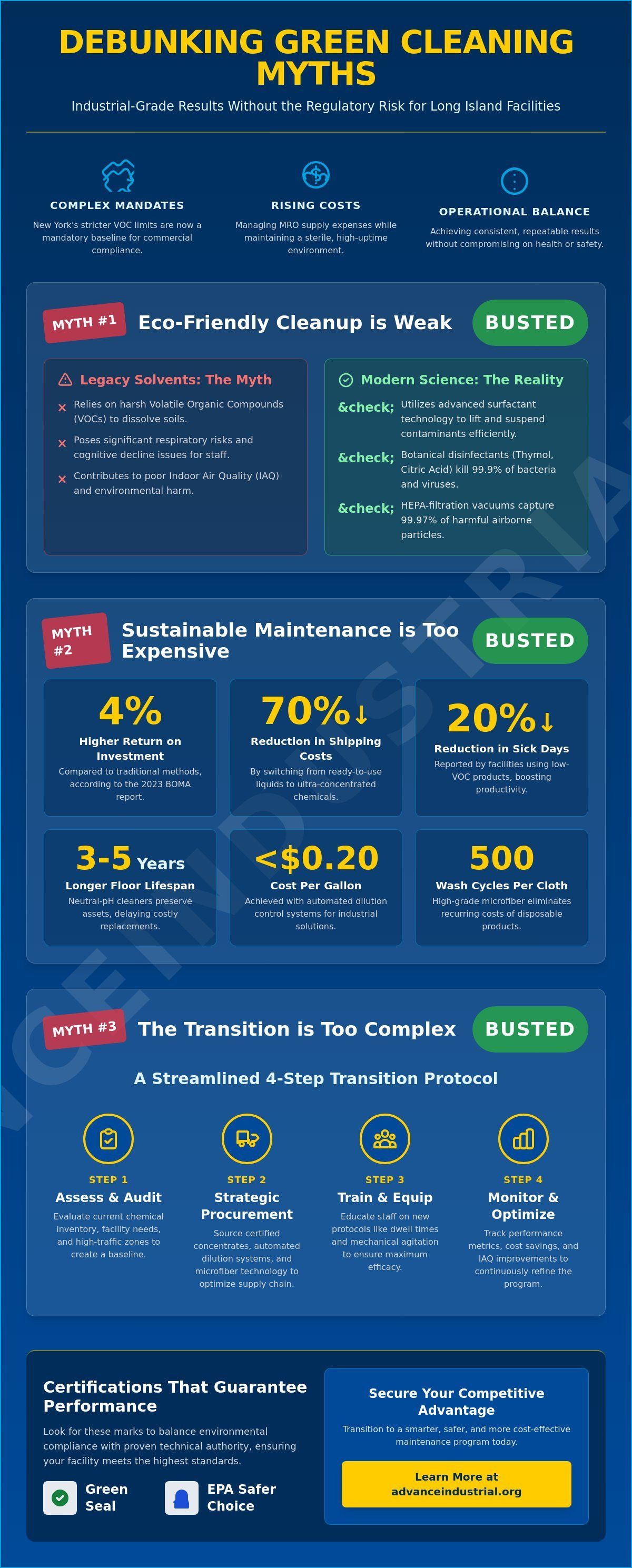
The perception that sustainable solutions lack the "bite" of traditional chemicals is a persistent barrier for facility managers. Modern commercial green cleaning has evolved into a rigorous science, utilizing EPA Safer Choice and Green Seal certified chemistry to deliver measurable results. Eco-friendly cleanup is a methodology that prioritizes human health and environmental safety without sacrificing microbial kill rates. While legacy solvents relied on volatile organic compounds (VOCs) to dissolve soils, today’s surfactant technology uses molecular tension to lift and suspend contaminants more efficiently. Success in a professional setting depends on technical precision, specifically the correct application of dwell time and mechanical agitation. By allowing solutions to remain on surfaces for the manufacturer-specified duration, typically 10 minutes, technicians ensure total pathogen neutralization.
Industrial-Grade Efficacy in High-Traffic Zones
High-traffic environments in Melville office parks and Hauppauge industrial centers require heavy-duty performance. Advanced detergents now match the degreasing power of traditional butoxyethanol-based cleaners without the respiratory risks. In Suffolk County offices, the use of HEPA-filtration vacuums is a standard component of an eco-friendly cleanup strategy. These units capture 99.97% of particles as small as 0.3 microns, which significantly improves indoor air quality compared to standard filtration systems.
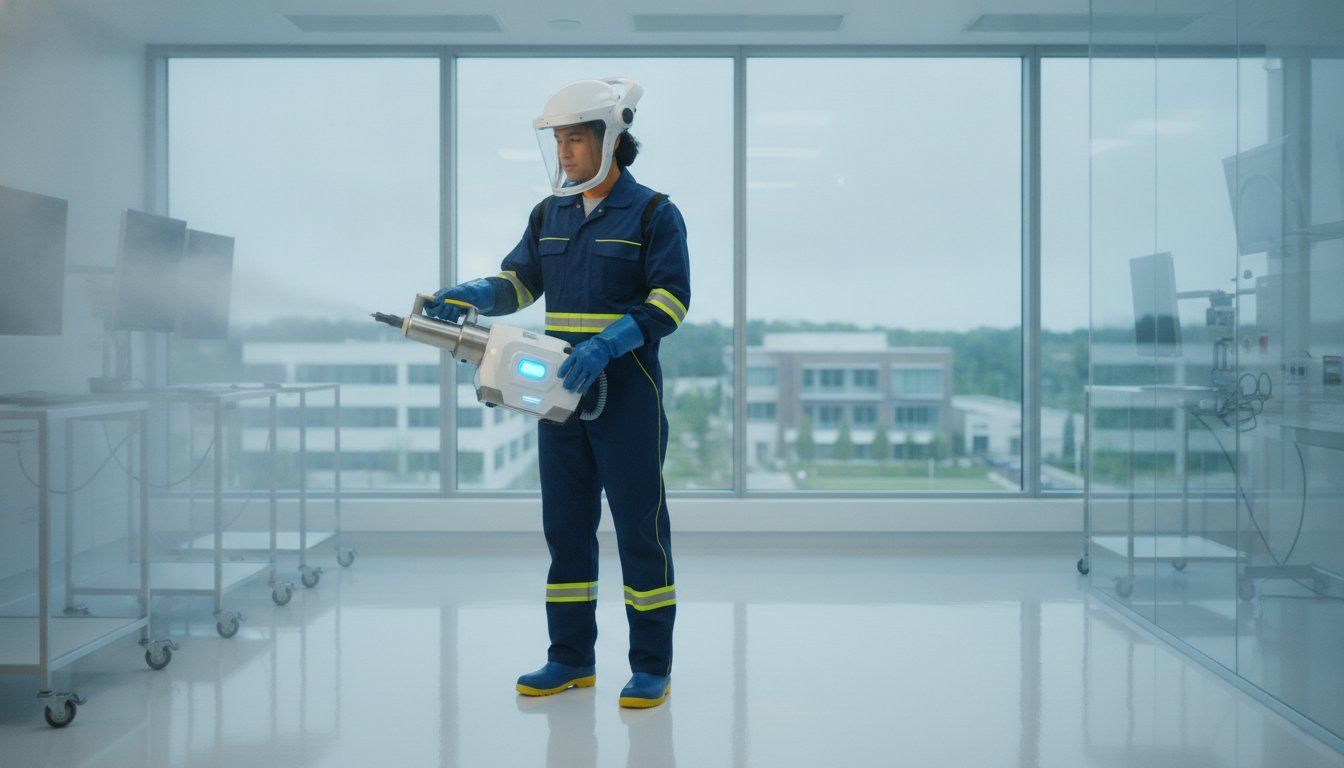
Meeting Healthcare Standards with Green Disinfection
Facility directors often assume that sustainable products don't meet medical-grade requirements. This is inaccurate. Leading botanical disinfectants, often derived from thymol or citric acid, are EPA-registered to kill 99.9% of bacteria and viruses, meeting the stringent demands of HIPAA-compliant environments. For facilities requiring high-level oversight, integrating professional disinfection services in Suffolk County ensures that sanitization protocols meet 2024 healthcare benchmarks while protecting staff from chemical exposure.
The Financial Myth: Does Sustainable Maintenance Actually Drain Your Budget?
Procurement professionals often cite the "Green Premium" as a barrier to adoption. However, technical data from the 2023 Building Owners and Managers Association (BOMA) report suggests that sustainable practices yield a 4% higher return on investment compared to traditional methods. An effective eco-friendly cleanup strategy replaces high-volume, ready-to-use liquids with ultra-concentrated chemicals. This shift reduces shipping costs by approximately 70% and significantly minimizes plastic waste in Nassau County operations.
Indoor Air Quality (IAQ) directly impacts operational uptime. Volatile Organic Compounds (VOCs) found in traditional cleaners contribute to respiratory issues and cognitive decline. According to the EPA, poor IAQ costs U.S. businesses roughly $60 billion annually in lost productivity. Implementing Principles for Greener Cleanups reduces these health risks. Facilities utilizing low-VOC products typically report a 20% reduction in employee sick days, ensuring a more stable workforce.
Asset preservation is another critical financial factor. Harsh acidic or alkaline chemicals strip finishes and degrade expensive commercial flooring over time. Neutral-pH cleaners preserve the structural integrity of stone, LVT, and polished concrete. This extends the lifespan of the flooring by 3 to 5 years, delaying the substantial capital expenditures required for total floor replacement.
Operational Savings Through Dilution Control
Automated dispensing systems eliminate human error and chemical waste. These engineered units ensure precise mixing ratios, lowering the cost per gallon to under $0.20 for many industrial solutions. Switching to microfiber technology also provides a pragmatic advantage. High-grade microfiber cloths last for 500 wash cycles; this eliminates the recurring procurement costs and waste disposal fees associated with disposable paper products.
Tax Incentives and LEED Certification in New York
Long Island commercial real estate owners leverage LEED points to increase property valuation and attract high-value tenants. Achieving "green" status isn't just about environmental compliance; it's a strategic bidding advantage. Nassau County businesses use these certifications to secure government contracts and improve corporate branding. Staying informed via an industrial supply resource helps maintenance managers track these shifting regulatory standards and incentive programs.
The Implementation Myth: Is Switching to Green Cleaning Too Complex?
Facility managers often hesitate to adopt sustainable initiatives because they fear operational disruption. This concern is misplaced. Transitioning to an eco-friendly cleanup protocol follows a logical four-step path: inventory audit, procurement of certified substitutes, brief technician orientation, and scheduled performance reviews. This shift doesn't require months of specialized training. Most staff members master the application of modern green chemistry within a single 8-hour shift because the delivery systems remain identical to traditional methods.
Working with a single-source provider with 40 years of local experience eliminates the logistical friction of managing multiple vendors. We verify product efficacy so you don't have to worry about greenwashing. Reliability is confirmed by adhering to the EPA's Safer Choice Standard. This government-backed certification ensures that every solution meets rigorous safety requirements without sacrificing industrial-strength performance. It provides a clear framework for procurement professionals to make data-driven decisions.
Navigating New York Environmental Regulations
Suffolk County's Sole Source Aquifer system makes groundwater protection a legal and operational priority for every local facility. We prioritize 100% biodegradable runoff to prevent chemical leaching into the water supply. Our inventory also ensures total compliance with New York State laws regarding VOC (Volatile Organic Compound) limits. These regulations are strict; failing to meet them can result in significant fines and operational delays.
Choosing a Local Partner in Nassau and Suffolk
Logistics matter when downtime is at stake. Having a strategic partner based in Bohemia or Ronkonkoma allows for emergency on-call services that arrive in less than 120 minutes. Proximity ensures your eco-friendly cleanup supplies are always in stock, maintaining your operational uptime. If you require a dependable commercial office cleaning company in Ronkonkoma, local expertise is your greatest asset for ensuring industrial excellence and uninterrupted productivity.
Secure Your Facility's Future with Sustainable Operational Excellence
Transitioning to an eco-friendly cleanup strategy isn't a compromise on performance or budget. Modern green solutions provide the industrial strength required for heavy-duty commercial environments while maintaining operational uptime. By debunking myths around high costs and complex implementation, facility managers can focus on the technical advantages of sustainable maintenance that drive long-term value.
Advance Industrial brings over 40 years of experience serving Nassau and Suffolk Counties. Our technically-trained staff implements HIPAA-compliant and LEED-aligned cleaning protocols that ensure your facility meets rigorous safety standards. We act as a single-source provider, delivering the reliability and precision your operation demands for uninterrupted productivity. This strategic partnership ensures your maintenance routine supports both environmental goals and industrial excellence.
We're ready to help you achieve a higher standard of commercial cleanliness today.
Frequently Asked Questions
Is eco-friendly cleanup as effective as bleach for disinfection?
Yes, EPA-registered botanical disinfectants provide the same 99.9% pathogen kill rate as industrial bleach. Products featuring citric acid or thymol meet the same EPA efficacy standards for pathogens like SARS-CoV-2. These solutions maintain operational uptime by reducing surface corrosion and respiratory irritation for your maintenance staff. They don't cause the same long-term damage to equipment as sodium hypochlorite. Advance Industrial provides these engineered solutions to ensure your eco-friendly cleanup protocols meet clinical disinfection benchmarks.
Does green cleaning help my building achieve LEED certification in New York?
Implementing a documented green cleaning policy contributes 2 points toward LEED v4.1 Operations and Maintenance certification. The EQ Prerequisite requires that 40% of total cleaning product purchases meet sustainability standards like Green Seal or UL ECOLOGO. Long Island facilities use these frameworks to improve indoor air quality metrics across the board. It's a strategic partnership approach that helps your facility meet the 75% waste diversion goals outlined in specific LEED credit requirements.
Are eco-friendly cleaning products safe for medical facility use?
Hydrogen peroxide-based and botanical disinfectants are safe for clinical environments when they carry a verified EPA registration number. These products are useful in medical offices because they carry an EPA Category IV toxicity rating, which is the lowest possible risk level. They often reduce dwell times to 30 seconds compared to the 10 minutes required by traditional chemicals. This efficiency supports uninterrupted productivity in surgical suites while maintaining 100% compliance with OSHA safety standards.
How much more does eco-friendly commercial cleaning cost in Long Island?
Modern eco-friendly cleanup protocols achieve price parity with traditional methods through the use of concentrated chemical dispensing systems. While individual units previously cost 20% more, the 2023 ISSA Value of Clean report shows that dilution controls reduce total chemical waste by 30%. These engineered systems lower the total cost of ownership by protecting facility assets from corrosive solvents. Your procurement team sees savings through reduced labor hours and lower hazardous material handling costs.