Optimizing Your Commercial Window Cleaning Schedule in Long Island (2026)

What if the primary threat to your facility's long-term value is not internal wear, but the specific atmospheric conditions of Long Island itself? For procurement professionals managing properties near the Atlantic coastline or the Long Island Expressway, the accumulation of salt crystals and carbon film represents a significant operational risk. You likely understand that a reactive approach leads to permanent glass etching and inflated restoration costs over time. Establishing a technically sound window cleaning schedule is the first step toward transitioning from emergency maintenance to a model of industrial excellence and predictable asset management.
This guide provides the framework to design a high-performance maintenance plan tailored to our region's unique 2026 environmental profile. You'll learn how to mitigate the 15% faster rate of mineral degradation found in coastal zones while ensuring a professional appearance for your clients and patients. We will analyze the specific frequencies required to counteract industrial pollutants, helping you secure a strategic partnership with a single-source provider that prioritizes both your budget and your building's structural integrity.
Key Takeaways
- Identify how Long Island’s unique coastal geography and salt spray levels dictate the necessary maintenance frequency for your facility’s exterior.
- Design a customized window cleaning schedule that balances high-visibility requirements for retail storefronts with quarterly deep cleans for corporate office parks.
- Execute a site-specific environmental load assessment to quantify the impact of industrial pollutants and humidity on your building’s operational uptime.
- Integrate specialized window maintenance into your broader janitorial service contracts to ensure a streamlined, single-source approach to facility management.
Critical Factors Influencing a Window Cleaning Schedule in Long Island
A commercial window cleaning schedule functions as a strategic maintenance plan that accounts for environmental load and facility usage. It's a technical requirement for preserving building assets and ensuring long-term structural integrity. Facilities that operate without a structured plan often face accelerated glass degradation and higher MRO costs. For procurement professionals, this schedule is a tool to maintain operational uptime and professional standards.
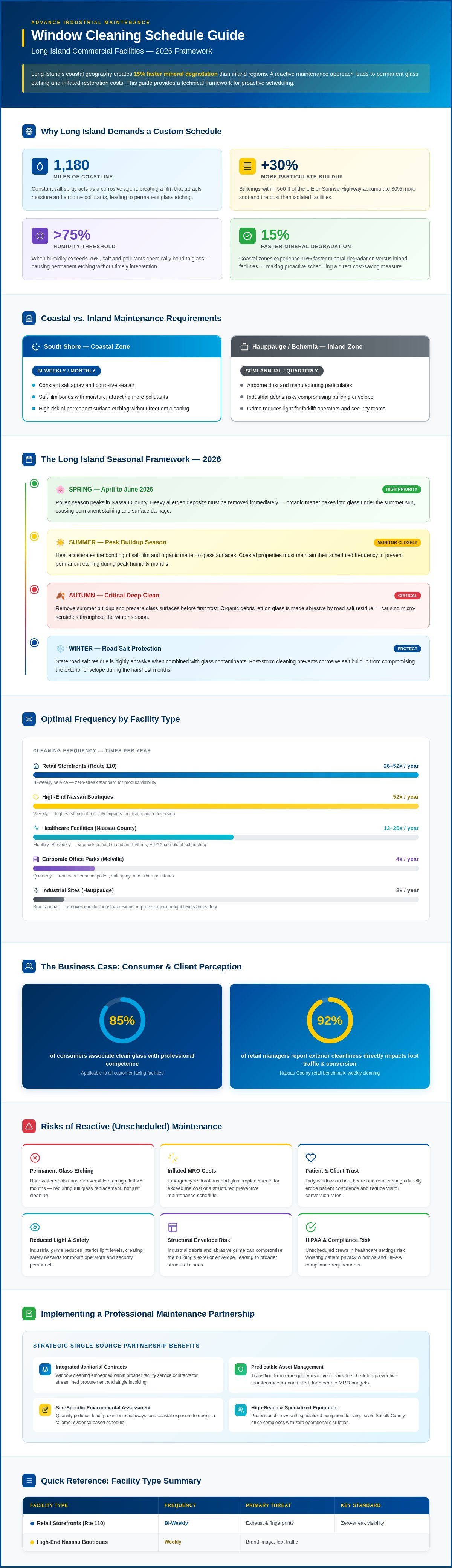
Long Island’s unique coastal geography dictates the frequency of these services. Properties situated near the 1,180 miles of coastline face constant exposure to salt spray. This salt air acts as a corrosive agent, creating a film that attracts moisture and airborne pollutants. When humidity levels exceed 75 percent, these contaminants bond to the glass surface, leading to permanent etching if not addressed through a consistent window cleaning schedule .
Urban pollutants also play a major role in debris accumulation. Proximity to the Long Island Expressway or Sunrise Highway increases the volume of soot and tire dust on exterior surfaces. Traffic data indicates that buildings within 500 feet of these high-density corridors experience 30 percent more particulate buildup than isolated facilities. Regular removal of these deposits is essential to prevent the buildup of abrasive grime that can scratch glass during standard cleaning cycles.
Coastal vs. Inland Maintenance Requirements
South Shore properties require a high-frequency maintenance cycle to mitigate the effects of salt air. This corrosive element demands bi-weekly or monthly attention to prevent surface damage. Inland industrial parks, such as those in Hauppauge and Bohemia, face different challenges. These facilities contend with airborne dust and manufacturing particulates. Maintenance in these zones focuses on removing industrial debris to ensure that debris doesn't compromise the building's exterior envelope or visibility.
The Long Island Seasonal Framework
- Spring: The 2026 pollen season is projected to peak between April and June. Heavy allergen deposits in Nassau County require immediate removal to prevent organic matter from baking into the glass under the summer sun.
- Autumn: This period is critical for removing summer buildup and preparing surfaces for the New York winter. Clearing organic debris before the first frost protects the glass from the abrasive salt residue used on state roads.
Determining the Optimal Frequency for Your Facility Type
Establishing an effective window cleaning schedule requires a technical analysis of environmental exposure and facility usage. Retail storefronts along the Route 110 corridor face constant exhaust and fingerprint accumulation. These locations require bi-weekly service to maintain brand standards. 85% of consumers associate clean glass with professional competence. In contrast, Melville corporate parks often operate on a quarterly cycle. This frequency removes seasonal pollen and salt spray without disrupting daily operations or tenant workflows.
Healthcare Facility Standards in Nassau County
Patient wellness in 2026 relies heavily on access to natural light. Clean windows support circadian rhythms and provide a sterile appearance essential for patient trust. Facilities must coordinate window maintenance with recurring medical facility cleaning protocols. This integration ensures exterior maintenance doesn't interfere with strict sanitation windows. HIPAA compliance is maintained through scheduled, professional crews who respect patient privacy during all exterior glass work. Regular cleaning also prevents the buildup of organic matter that can compromise facility hygiene standards.
Retail vs. Corporate Office Requirements
Retail glass demands a zero-streak standard to facilitate product visibility. 92% of retail managers report that exterior cleanliness directly impacts foot traffic and conversion rates. Weekly cleanings are the benchmark for high-end Nassau boutiques. Large-scale Suffolk County office complexes prioritize strategic quarterly schedules. These projects often involve high-reach equipment and require precise coordination to ensure uninterrupted productivity. A structured approach prevents the accumulation of hard water spots which can cause permanent glass etching if left for more than six months.
Industrial sites in Hauppauge focus on safety and functional visibility. Grime buildup reduces light levels for forklift operators and security teams. A semi-annual window cleaning schedule provides several operational benefits:
- Removal of caustic industrial dust and metallic particulates.
- Enhanced visibility for perimeter security and loading dock safety.
- Prevention of glass degradation from chemical runoff.
- Maintenance of a professional environment for visiting stakeholders.
Industrial excellence requires attention to these details to avoid long-term asset depreciation. Maintaining these standards supports uninterrupted productivity throughout the fiscal year.
Implementing a Professional Maintenance Partnership
Transitioning from reactive cleaning to a managed partnership requires a structured onboarding process. Facility managers should follow a four-step implementation strategy to ensure operational continuity. First, conduct a site-specific environmental load assessment. This evaluation measures local pollutants, such as salt spray in coastal Long Island zones or particulate matter from high-traffic corridors like the I-495. Second, align cleaning cycles with your existing janitorial service contract. This integration reduces administrative overhead and ensures that exterior maintenance doesn't conflict with interior operations. Third, verify safety compliance and insurance for high-rise or specialized equipment. Contractors must provide proof of coverage for specialized rigging and aerial lifts. Finally, establish a recurring window cleaning schedule to lock in predictable maintenance costs. This proactive approach prevents the accumulation of corrosive materials that can lead to glass degradation.
Safety and Industrial Compliance
Commercial window cleaning at height demands strict adherence to OSHA 1910.27 standards. Professional partners utilize engineered anchor points and certified descent systems rather than standard ladders. High-performance facility management relies on industrial-grade squeegees, deionized water systems, and specialized scrapers. These tools prevent scratches and ensure a streak-free finish that standard janitorial equipment can't achieve. Using the wrong tools often results in permanent damage to high-performance glass coatings, which increases long-term replacement costs. It's a matter of technical precision and risk mitigation.
Integrating Windows into a Comprehensive Facility Plan
Window maintenance is a critical component of building envelope health. Regular inspections during cleaning sessions can identify seal failures or masonry issues before they escalate into structural leaks. By leveraging janitorial services in New York, firms gain a single-source maintenance solution. This strategic partnership ensures that every square foot of the facility, from the warehouse floor to the top-floor glazing, receives consistent care. Maintaining a rigorous window cleaning schedule supports industrial excellence by preserving the professional appearance and structural integrity of the asset. Reliability in these small details ensures uninterrupted productivity for the entire operation.
Stabilizing Your Long Island Infrastructure for 2026
Developing a rigorous window cleaning schedule isn't just about aesthetics; it's a critical component of maintaining your facility's operational uptime. By analyzing specific environmental factors like coastal salt exposure and high-traffic particulate accumulation, plant managers can prevent long-term glass degradation. Advance Industrial leverages over 40 years of Long Island experience to deliver engineered maintenance solutions that meet strict OSHA-compliant safety protocols. We operate as a single-source provider, ensuring your building's exterior reflects the same professional standards as your internal operations. This strategic partnership approach eliminates the complexities of vendor management while maintaining industrial excellence across your entire footprint. It's time to transition from reactive cleaning to a structured maintenance cycle that protects your physical assets and supports uninterrupted productivity. Request a customized window cleaning assessment for your Long Island facility to secure a reliable maintenance partner committed to your long-term success. We look forward to strengthening your facility's resilience.
Frequently Asked Questions
How often should Long Island businesses clean their windows?
Long Island businesses should establish a window cleaning schedule based on their facility's proximity to the Atlantic coast and local traffic density. High-traffic retail locations require weekly service to maintain brand standards, while industrial facilities typically operate on a quarterly 90-day rotation. Data indicates that 75% of Long Island office parks maintain a semi-annual frequency to mitigate salt spray corrosion and preserve glass integrity.
Does rain affect my scheduled commercial window cleaning?
Scheduled cleaning operations proceed during light precipitation, as rain water lacks the mineral content that causes spotting. We suspend services only when wind speeds exceed 25 miles per hour or lightning is detected within a 10-mile radius, adhering to OSHA safety standards. This protocol ensures operational continuity while prioritizing the safety of the technical crew and your facility's assets.
What is the best month to schedule window cleaning in New York?
April and October are the peak months for optimizing your facility maintenance in New York. An April service removes the 3 to 5 months of winter salt and grime accumulation that can etch glass surfaces if left untreated. October appointments prepare the building envelope for winter, ensuring that 100% of the glass surface is clear before freezing temperatures arrive.
How do I know if my facility needs a professional window cleaning schedule?
A professional window cleaning schedule is necessary when particulate matter reduces natural light transmission by 15% or more. If your maintenance logs show salt crusting or industrial fallout from nearby transit hubs, a strategic partnership is required to prevent permanent glass degradation. Consistent scheduling ensures uninterrupted productivity by eliminating the need for emergency reactive maintenance and preserving the long-term value of your real estate.