Professional Commercial Window Cleaning in Suffolk and Nassau County, Long Island
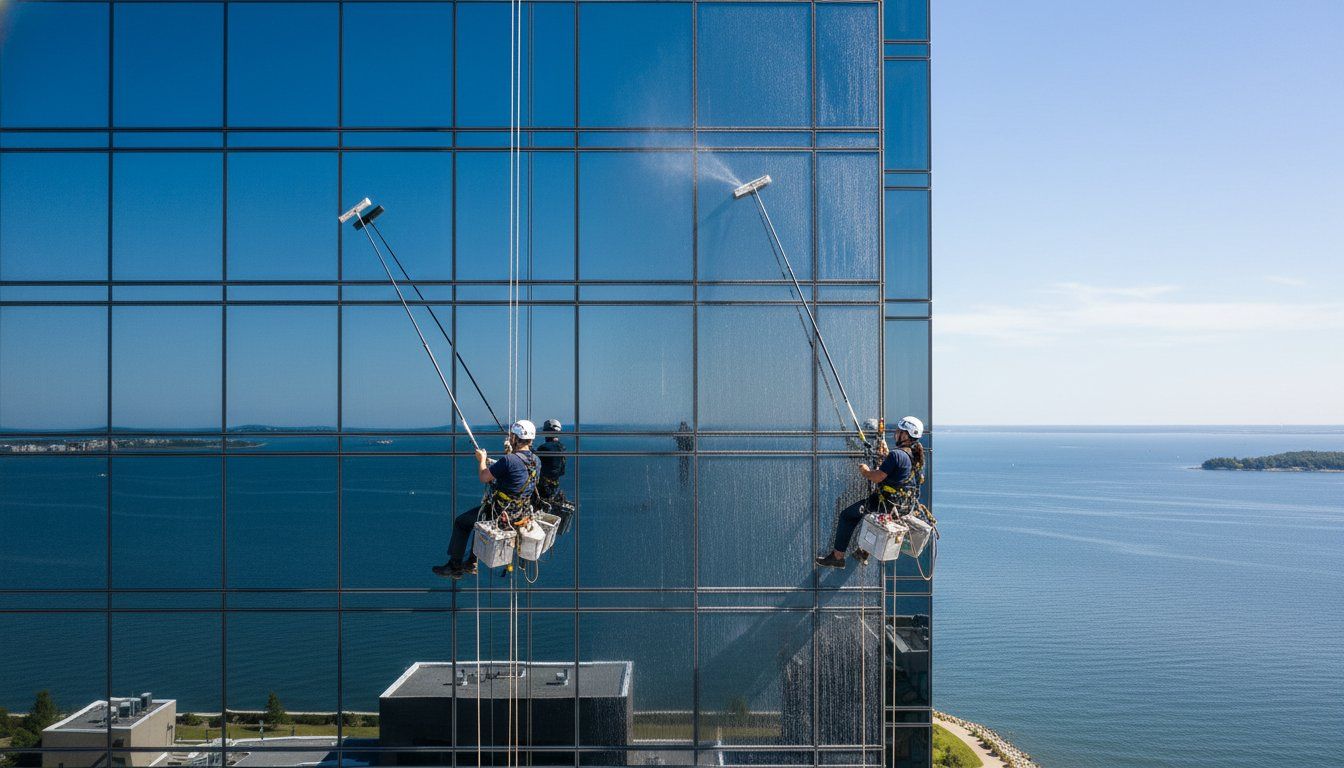
Neglecting the exterior envelope of a commercial facility in Suffolk or Nassau County leads to more than just a poor corporate image; it results in the accelerated failure of structural glazing systems. You recognize that salt air from the Atlantic Ocean and Long Island Sound acts as a persistent corrosive agent, capable of reducing the lifespan of window seals by 30 percent if left untreated. Maintaining a consistent schedule for professional window cleaning is not a luxury but a critical component of your MRO strategy to prevent permanent glass etching and frame oxidation.
Advance Industrial provides this comprehensive reference guide to help facility managers transition from reactive cleaning to a proactive maintenance partnership. You'll gain a technical understanding of specialized glass treatments designed for high-salinity environments and the safety frameworks necessary for a zero-incident record on high-rise assets. This guide outlines the specific protocols for selecting a single-source provider that ensures your facility maintains maximum operational uptime and structural integrity throughout the 1,180 miles of Long Island coastline.
Key Takeaways
- Identify how specific coastal stressors like Atlantic salt spray and high humidity degrade Suffolk County glass assets over time.
- Compare the operational efficiency of traditional methods against advanced Water Fed Pole technology and "Pure Water" filtration systems.
- Learn to integrate professional window cleaning into a single-source janitorial model to enhance overall facility MRO efficiency.
- Discover how to leverage 40 years of regional expertise to ensure uninterrupted productivity and maximum asset lifespan.
- Develop a strategic maintenance schedule designed to maintain industrial excellence and operational uptime across Long Island commercial hubs.
The Technical Challenges of Commercial Window Cleaning on Long Island
Commercial window cleaning functions as a specialized MRO (Maintenance, Repair, and Operations) category essential for preserving the structural integrity of a building's envelope. On Long Island, glass assets in Suffolk County face constant exposure to Atlantic salt spray and coastal humidity. These environmental factors create a corrosive layer that demands more than aesthetic maintenance. Standard janitorial methods often fail on large-scale commercial facades in industrial hubs like Melville and Hauppauge because they lack the specialized equipment to remove mineral deposits. Without professional intervention, these deposits lead to permanent glass etching and frame oxidation, which can decrease the lifespan of window seals by up to 15 years and threaten uninterrupted productivity.
Salt Air and Environmental Corrosion in Nassau and Suffolk
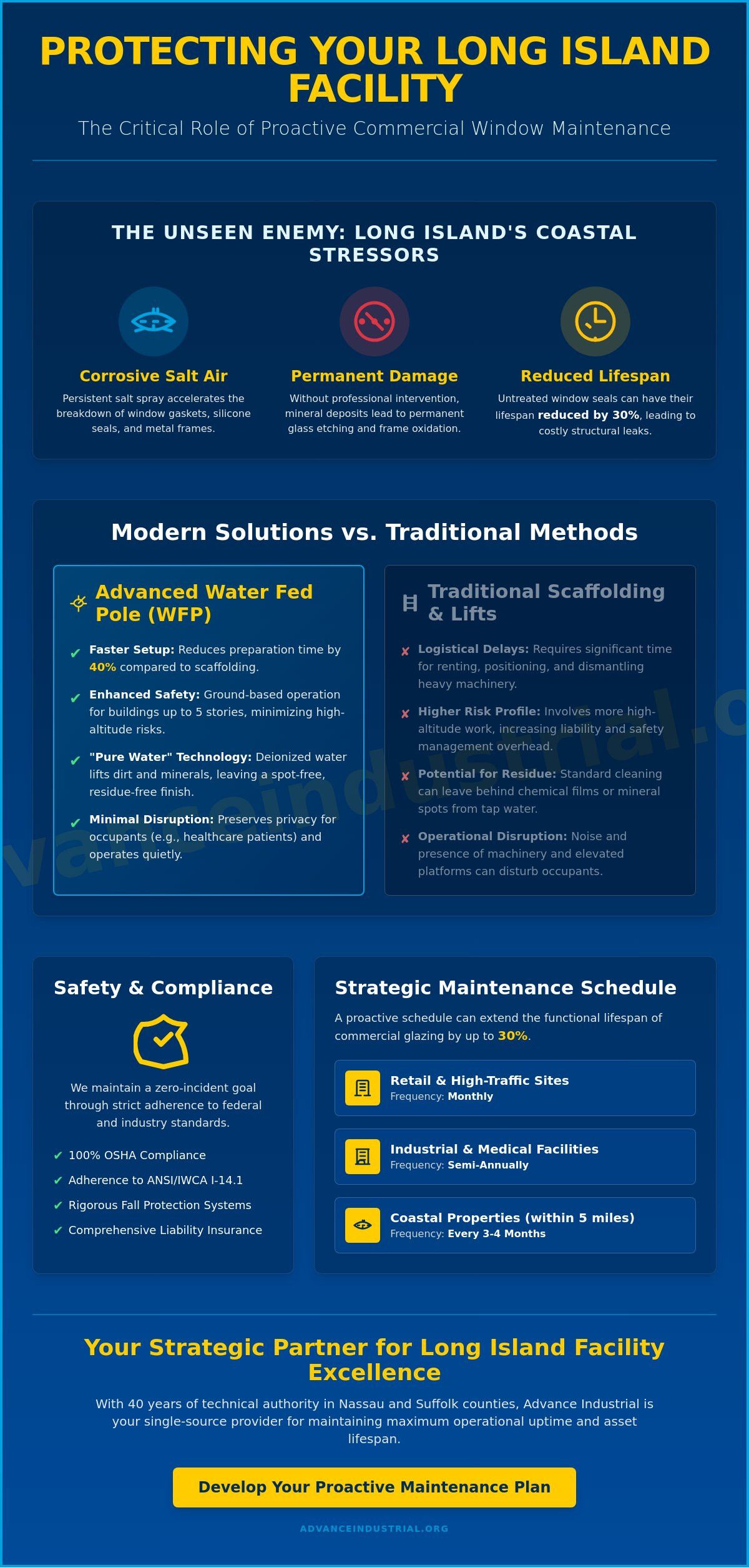
Sodium chloride buildup is a primary driver of material degradation for coastal properties. When salt air lingers on glass surfaces, it accelerates the breakdown of window gaskets and silicone seals. Facilities within 5 miles of the shore require cleaning cycles every 3 to 4 months to prevent salt-induced pitting. Utilizing advanced window cleaning techniques ensures that these abrasive particles are fully neutralized before they bond to the glass matrix. It's a proactive maintenance schedule that protects the building's thermal efficiency and prevents costly structural leaks.
OSHA Compliance and High-Rise Safety Standards
Operating on multi-story office buildings and healthcare facilities requires strict adherence to safety protocols to mitigate liability. Our teams implement rigorous fall protection systems and anchor point inspections to maintain 100% compliance with federal regulations. The ANSI/IWCA I-14.1 is the national safety standard that governs exterior building maintenance by establishing requirements for equipment testing and technician training on high-rise structures. This commitment to safety fosters a strategic partnership that ensures every project at a Nassau County medical campus is completed without operational downtime.
Evaluating Commercial Window Cleaning Methods and Equipment
Effective facility management requires selecting window cleaning methods that balance speed with technical precision. Traditional squeegee techniques provide high-detail results for interior surfaces, yet modern Water Fed Pole (WFP) technology dominates exterior industrial applications. WFP systems utilize deionized "Pure Water" to lift particulates without chemical residue. The process eliminates mineral spotting on large-scale glazing. Utilizing specialized equipment increases operational uptime by removing the logistical delays associated with renting and positioning heavy lift machinery.
High-access projects in New York demand strict adherence to the ANSI/IWCA I-14.1 safety standard. The regulation defines the technical requirements for secure anchor points and descent systems. Procurement teams should verify that vendors carry comprehensive liability insurance. It's a necessary step to mitigate risks associated with high-altitude work and ensure industrial continuity.
Water Fed Pole Systems vs. Traditional Scaffolding
Reach-and-wash systems offer a superior cost-benefit ratio for buildings up to five stories. Using carbon fiber poles reduces setup time by 40% compared to traditional scaffolding or aerial platforms. For healthcare and medical offices, ground-based cleaning preserves patient privacy by keeping technicians off elevated platforms outside sensitive windows. This method supports uninterrupted productivity without the noise of heavy engines.
Developing a Strategic Window Maintenance Schedule
Frequency depends on facility function. Retail sites typically require monthly service to maintain brand standards, while industrial warehouses benefit from semi-annual cleaning. Consistent maintenance schedules can extend the functional lifespan of commercial glazing by up to 30%. Proactive approaches prevent the permanent etching of glass caused by salt air and industrial pollutants. Staying informed on industrial maintenance trends ensures your facility remains a high-performance asset through a strategic partnership.
Advance Industrial: Your Strategic Partner for Long Island Facility Excellence
Advance Industrial brings 40 years of technical authority to Nassau and Suffolk County commercial hubs. We operate as a single-source provider, integrating professional window cleaning into a comprehensive maintenance framework. This approach eliminates the need to manage disparate contractors. It ensures facility managers maintain high operational uptime. Our team understands that clean glass is a component of a larger, engineered facility strategy. We deploy professional staff equipped with industrial-grade tools to handle the most demanding architectural glass requirements across Long Island.
Medical facilities require a higher standard of care. Our customized solutions for healthcare environments prioritize strict sanitation and absolute discretion. We align our workflows with your facility's specific compliance needs. This prevents operational friction. By leveraging advanced equipment, we ensure that maintenance activities never disrupt patient care or administrative productivity. We treat your facility as a mission-critical environment where precision is the only acceptable standard.
Integrated Facility Solutions for Melville and Ronkonkoma
Bundling window care with recurring janitorial services creates a streamlined maintenance schedule for high-density hubs in Melville and Ronkonkoma. This synergy improves floor care and office hygiene through a unified management point. A single-source model reduces administrative overhead for procurement professionals. Facilities benefit from a cohesive strategy that addresses both the building envelope and internal workspace requirements simultaneously. We focus on the details so your team can focus on their core operations.
The Advance Industrial Commitment to Reliable Results
Our industrial strength service delivery focuses on technical precision and technical authority. We don't just provide a cleaning crew; we provide a strategic partnership rooted in reliability. We've spent four decades refining our processes to ensure your facility remains a benchmark of professionalism. This commitment to window cleaning and general maintenance protects your long-term asset value. Contact our team today for a professional site assessment and a tailored maintenance proposal designed for your facility's unique operational demands.
Secure Long-Term Operational Excellence for Your Facility
Maintaining a professional appearance and structural integrity on Long Island requires a technical approach to window cleaning . Facilities in Nassau and Suffolk County face unique environmental stressors, including salt air corrosion and high wind loads. Advance Industrial brings over 40 years of commercial cleaning experience to solve these specific regional challenges. Our teams utilize specialized equipment designed for industrial efficiency and technical precision. We maintain rigorous high-access safety protocols to protect your assets and our personnel during every engagement. For healthcare and medical facilities, our staff applies specialized sanitation expertise to meet strict regulatory standards. We don't just provide a service; we act as a single-source provider for your facility's continuity. Our pragmatic methods ensure your infrastructure remains a point of strength for your business operations. You can rely on our seasoned staff to deliver consistent results that support your long-term maintenance goals. We're ready to help you maintain a safe and productive environment.
We look forward to building a strategic partnership that enhances your facility's performance and professional standing.
Frequently Asked Questions
How often should a commercial building on Long Island have its windows cleaned?
Commercial properties on Long Island require professional window cleaning at least twice per year to maintain structural integrity and professional appearance. Retail locations in high-traffic areas like Melville often schedule monthly cleanings to manage heavy fingerprints and street grime. As a single-source provider, we ensure mid-rise office complexes in Suffolk County maintain a quarterly schedule. This frequency prevents the accumulation of corrosive particulates that can degrade glass surfaces over time.
What is the difference between residential and professional commercial window cleaning?
Professional commercial window cleaning utilizes industrial-grade equipment and OSHA-compliant safety protocols that residential services don't typically provide. Commercial technicians use water-fed pole systems and specialized deionized water filtration to ensure a streak-free finish on large-scale glass installations. While residential work focuses on aesthetic maintenance, commercial operations prioritize operational uptime and strict adherence to ANSI/IWSCA I-14.1 safety standards for high-access projects.
Is window cleaning included in standard janitorial service contracts?
Standard janitorial contracts usually exclude exterior window cleaning, focusing instead on internal surface sanitation and floor care. Most 5-day-a-week janitorial agreements limit glass work to interior partitions or entry door touch-ups. Exterior maintenance requires specialized insurance and technical rigging that standard cleaning crews don't possess. We frame our exterior services as a strategic partnership to complement your existing MRO supplies and facility maintenance schedule.
How does salt air affect the windows of my Nassau County office building?
Salt air in Nassau County causes sodium chloride crystals to bond with glass surfaces, leading to permanent etching if not removed within 90 days. Coastal properties within 5 miles of the Atlantic Ocean or Long Island Sound face 3 times the rate of mineral buildup compared to inland structures. Regular maintenance ensures industrial excellence by protecting the building envelope from these corrosive maritime conditions and preventing long-term glass degradation.