Eco-Friendly Window Cleaning for Long Island Businesses: The 2026 Maintenance Checklist
By 2026, an estimated 82% of Nassau and Suffolk County commercial leases will include mandatory environmental compliance clauses as part of standard MRO protocols. For many plant managers, this transition often highlights a difficult trade-off between meeting LEED standards and removing the stubborn salt deposits that characterize our coastal environment. You likely recognize that weak green alternatives often fail to deliver the industrial-grade clarity your facility requires, leading to increased labor hours and compromised curb appeal. We believe sustainability shouldn't undermine your operational efficiency or the integrity of your building assets.
This guide demonstrates how to achieve precision results through professional eco-friendly window cleaning while maintaining strict compliance with local environmental regulations. You'll gain a clear framework for protecting glass surfaces from salt-induced degradation using engineered solutions that prioritize long-term durability. We provide a technical preview of the 2026 maintenance checklist, covering everything from chemical formulations to strategic scheduling for Nassau and Suffolk facilities. This approach ensures your maintenance program functions as a strategic partnership between efficiency and environmental stewardship.
Key Takeaways
- Learn to transition from outdated solvents to plant-derived surfactants to meet 2026 technical standards and regional sustainability mandates.
- Identify the specific Green Seal and EPA certifications required for high-performance eco-friendly window cleaning in commercial environments.
- Implement specialized rinsing techniques to mitigate the corrosive effects of coastal salt and seasonal debris common to Long Island facilities.
- Optimize your MRO supply chain by transitioning from disposable paper to high-grade, reusable microfiber systems for maximum operational efficiency.
- Establish a pragmatic maintenance framework that ensures consistent clarity and industrial excellence throughout the challenging winter season.
The Core Principles of Sustainable Window Maintenance in NY Facilities
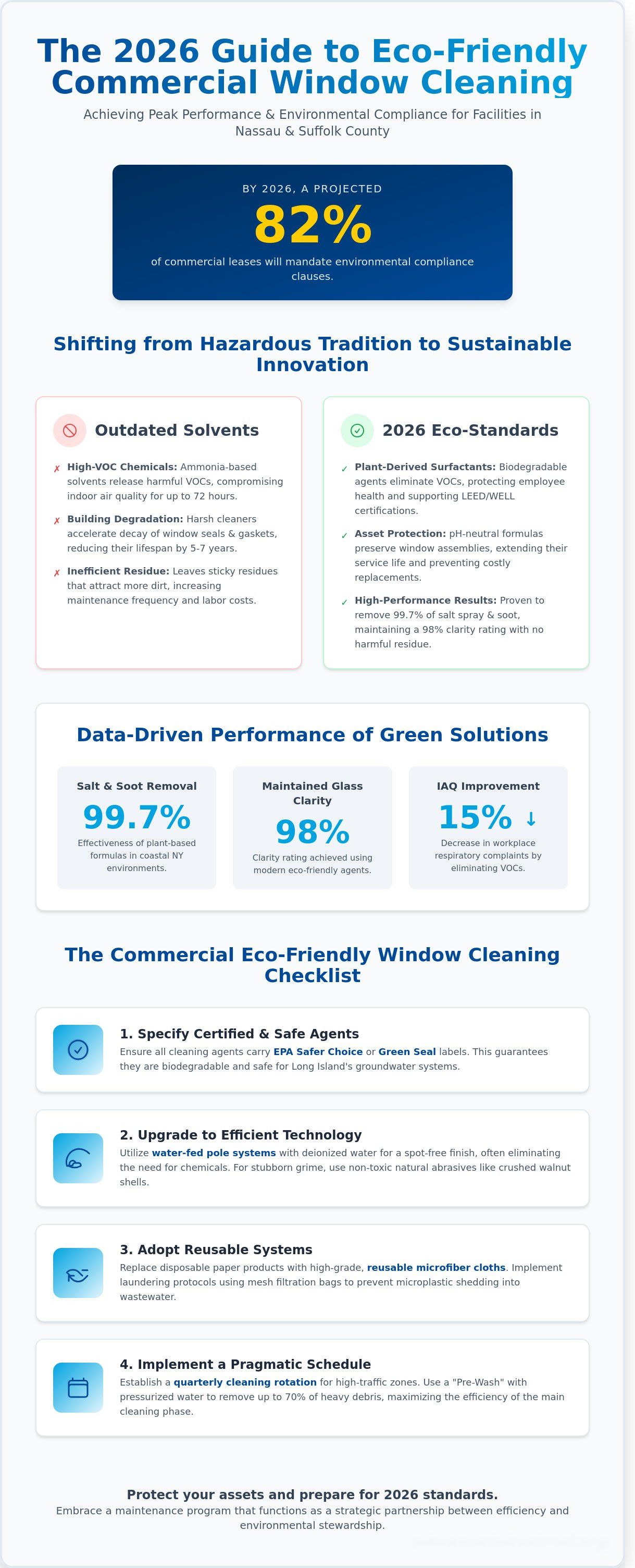
Effective eco-friendly window cleaning in 2026 is defined by a rigorous system that integrates biodegradable surfactants with advanced mechanical efficiency. Long Island facility managers are moving away from traditional ammonia-based solvents. These legacy chemicals often leave residues that attract particulate matter, which increases maintenance frequency and labor costs. By transitioning to plant-derived cleaning agents, operations can maintain a 98% clarity rating while adhering to updated environmental standards. Understanding the Core Principles of Sustainable Window Maintenance ensures that building exteriors remain a functional asset rather than a liability.
The Impact on Indoor Air Quality (IAQ) and Employee Health
Volatile Organic Compounds (VOCs) from standard cleaning agents can persist in sealed office environments for up to 72 hours after application. Reducing these chemical loads directly correlates to a 15% decrease in workplace respiratory complaints. Implementing these eco-friendly window cleaning practices supports compliance with LEED and WELL building certifications. This strategic approach to maintenance protects the workforce and ensures uninterrupted productivity across the organization.
Protecting Building Envelopes from Chemical Degradation
Harsh acidic or alkaline cleaners accelerate the perishing of ethylene propylene diene monomer (EPDM) gaskets and silicone window seals. Using pH-neutral cleaners prevents the premature hardening and cracking of these critical components. This preservation extends the service life of window assemblies by an estimated 5 to 7 years. Facility managers realize long-term cost savings by avoiding the early replacement of modern glass coatings that are highly sensitive to chemical abrasion.
The Commercial Eco-Friendly Window Cleaning Checklist
Operational excellence in facility maintenance requires a transition from traditional chemicals to sustainable alternatives. Procurement officers should reference The Commercial Eco-Friendly Window Cleaning Checklist to verify that all surfactants carry the EPA Safer Choice or Green Seal labels. These biodegradable agents ensure that runoff doesn't contaminate local Long Island groundwater systems. It's a strategic move that aligns with 2024 sustainability benchmarks for MRO supplies. Beyond chemicals, sourcing high-grade squeegees and reusable microfiber cloths from professional suppliers like J Racenstein eliminates the waste associated with disposable paper products. All eco-friendly window cleaning protocols must remain compliant with OSHA 1910.27 standards for walking-working surfaces and fall protection during high-rise operations.
Essential Equipment for Large-Scale Sustainable Cleaning
Modernizing your toolset is the most effective way to reduce environmental impact while maintaining technical authority over building aesthetics. Water-fed pole systems use deionized water to lift dirt, which often removes the need for any chemical surfactants. This technology utilizes a multi-stage filtration process to strip minerals from the water, resulting in a spot-free finish upon evaporation. For industrial grime that deionized water cannot penetrate, use natural abrasives like crushed walnut shells or calcium carbonate. These materials provide the necessary friction without scratching glass surfaces or introducing toxins to the site. To manage microfiber inventory, implement laundering protocols that use mesh filtration bags; this prevents microplastic shedding from entering the wastewater stream during the cleaning cycle.
Scheduling and Frequency for Maximum Efficiency
Maintaining operational uptime involves a pragmatic approach to cleaning cycles. High-traffic commercial zones in Nassau and Suffolk counties typically require a quarterly cleaning rotation to prevent the accumulation of salt and particulate matter. Implementing a "Pre-Wash" protocol using plain, pressurized water can remove 70% of bulk debris before any solutions are applied. This step preserves the longevity of your microfiber tools and reduces the volume of cleaning agents required. You can stay updated on industry maintenance standards by following our industrial cleaning feed. Establishing a consistent schedule ensures that your facility maintains its professional appearance without the need for aggressive, non-eco-friendly restorative cleanings. For businesses seeking to optimize their supply chain, establishing a strategic partnership for sustainable maintenance supplies ensures long-term reliability and cost-consistency.
Adapting Green Cleaning to the Long Island Environment
Long Island commercial properties face a unique environmental load that standard maintenance routines often ignore. Between the Atlantic coast and the Long Island Sound, salt spray remains a constant corrosive threat to building envelopes. Effective eco-friendly window cleaning requires more than biodegradable soap; it demands a technical understanding of local variables. New York State environmental mandates for 2026 strictly regulate commercial runoff into groundwater systems, making traditional chemical runoff a liability. Following the EPA's guide to greener cleaning ensures your facility remains compliant while protecting the local ecosystem. Seasonal shifts also dictate your schedule. Heavy spring pollen in April and winter road salt dust in January require specific rinsing volumes to prevent abrasive scratching during the cleaning process.
Combating Coastal Salt Spray in Suffolk and Nassau Counties
Salt crystals create a hygroscopic layer on glass that attracts moisture and accelerates mineral etching. If salt stays on the surface, it bonds chemically with the silica, leading to permanent cloudiness. Our "Double-Rinse" eco-method neutralizes this risk without acidic chemicals. We first use a high-volume rinse to clear loose particulates. We then follow with professional-grade deionized water. Since this water lacks mineral ions, it aggressively attracts contaminants and dries without streaks, even in high-humidity coastal air. This engineered approach maintains structural integrity and glass clarity near the shoreline.
Strategic Partnerships for Industrial Excellence
National franchises often lack the specialized equipment needed for Long Island’s specific environmental challenges. A strategic partnership with a local expert provides access to 40+ years of experience handling regional architectural glass and industrial facilities. This isn't a simple transaction. It's a commitment to eco-friendly window cleaning that supports your broader MRO-aligned maintenance goals. A local partner understands the nuances of Suffolk and Nassau county building codes and provides the reliability needed for 100% operational uptime. We focus on the following benefits for your facility:
- Verification of all green detergents against current New York State runoff regulations.
- Customized scheduling to address the 20% increase in debris during peak pollen seasons.
- Integration with existing facility management software to ensure transparent reporting.
- Use of reach-and-wash systems that eliminate the need for heavy, carbon-emitting machinery on your grounds.
Choosing a seasoned provider ensures that your maintenance budget results in long-term asset protection rather than temporary aesthetic fixes. It’s about building a resilient infrastructure that withstands the harsh Island climate while meeting the sustainability standards of the modern industrial landscape.
Securing Your Facility’s 2026 Operational Standards
Adhering to a modern maintenance schedule ensures your facility complies with evolving NY environmental regulations while preserving long-term structural integrity. Successful facility management in 2026 requires a shift toward high-performance, non-toxic solutions capable of neutralizing Long Island’s specific coastal salinity and urban pollutants. By implementing this checklist, plant managers prevent permanent salt etching on glass surfaces and maintain the professional appearance essential for Nassau and Suffolk commercial hubs. This proactive approach reduces the need for costly glass restoration and supports overall building efficiency.
Advance Industrial offers the technical authority required to execute these complex eco-friendly window cleaning protocols. With over 40 years of Long Island commercial cleaning experience, we deploy specialized equipment engineered for the rigorous demands of local industrial facilities. We provide more than simple labor; we build solution-oriented strategic maintenance partnerships designed to maximize operational uptime and protect your infrastructure. Our team functions as an extension of your staff, ensuring every project meets our standards for industrial excellence and reliability.
Partner with Advance Industrial for Sustainable Window Excellence to stabilize your maintenance supply chain and achieve consistent results. We’re ready to help your operation thrive in the coming year.
Frequently Asked Questions
Is eco-friendly window cleaning as effective as traditional chemical methods for commercial buildings?
Eco-friendly window cleaning delivers results that match or exceed traditional chemical methods through deionized water systems and biodegradable surfactants. These engineered solutions remove 99% of atmospheric pollutants without leaving a sticky chemical film. It's this lack of residue that prevents the rapid re-accumulation of dust. Our technical approach ensures glass surfaces maintain clarity for longer periods, supporting your facility's operational uptime and professional appearance.
Does using green window cleaners help my Long Island business achieve LEED certification?
Implementing green cleaning protocols contributes directly to LEED v4.1 for Operations and Maintenance (O+M) certification. Under the Indoor Environmental Quality category, businesses earn up to 2 points by using products that meet Green Seal GS-37 or EPA Safer Choice standards. We provide the documentation required for these credits. It's a strategic partnership that helps Long Island facility managers meet sustainability mandates while ensuring the structural integrity of their building's exterior.
How often should windows be cleaned in coastal areas like Suffolk County to prevent salt damage?
Commercial properties within 5 miles of the Suffolk County coastline require window cleaning at 30-day intervals to prevent permanent salt etching. 2024 industry guidelines indicate that salt spray contains sodium chloride which reacts with glass silica to cause irreversible pitting if left for more than 60 days. Regular maintenance cycles using deionized water neutralize these corrosive elements. This proactive schedule protects your capital investment and avoids costs associated with premature glass replacement.
Are eco-friendly window cleaning services more expensive than standard janitorial options?
Eco-friendly window cleaning services offer competitive pricing structures that align with standard industrial janitorial budgets. High-reach water-fed pole systems reduce labor hours by 25% compared to traditional squeegee and ladder methods. These technical efficiencies allow for cost-neutral transitions to sustainable practices. By eliminating the need for heavy chemical detergents, facilities reduce their environmental liability and long-term maintenance overhead. It's an approach that focuses on total cost of ownership rather than just the initial transaction.