Commercial Grout Cleaning Challenges in Long Island: Myth-Busting for 2026

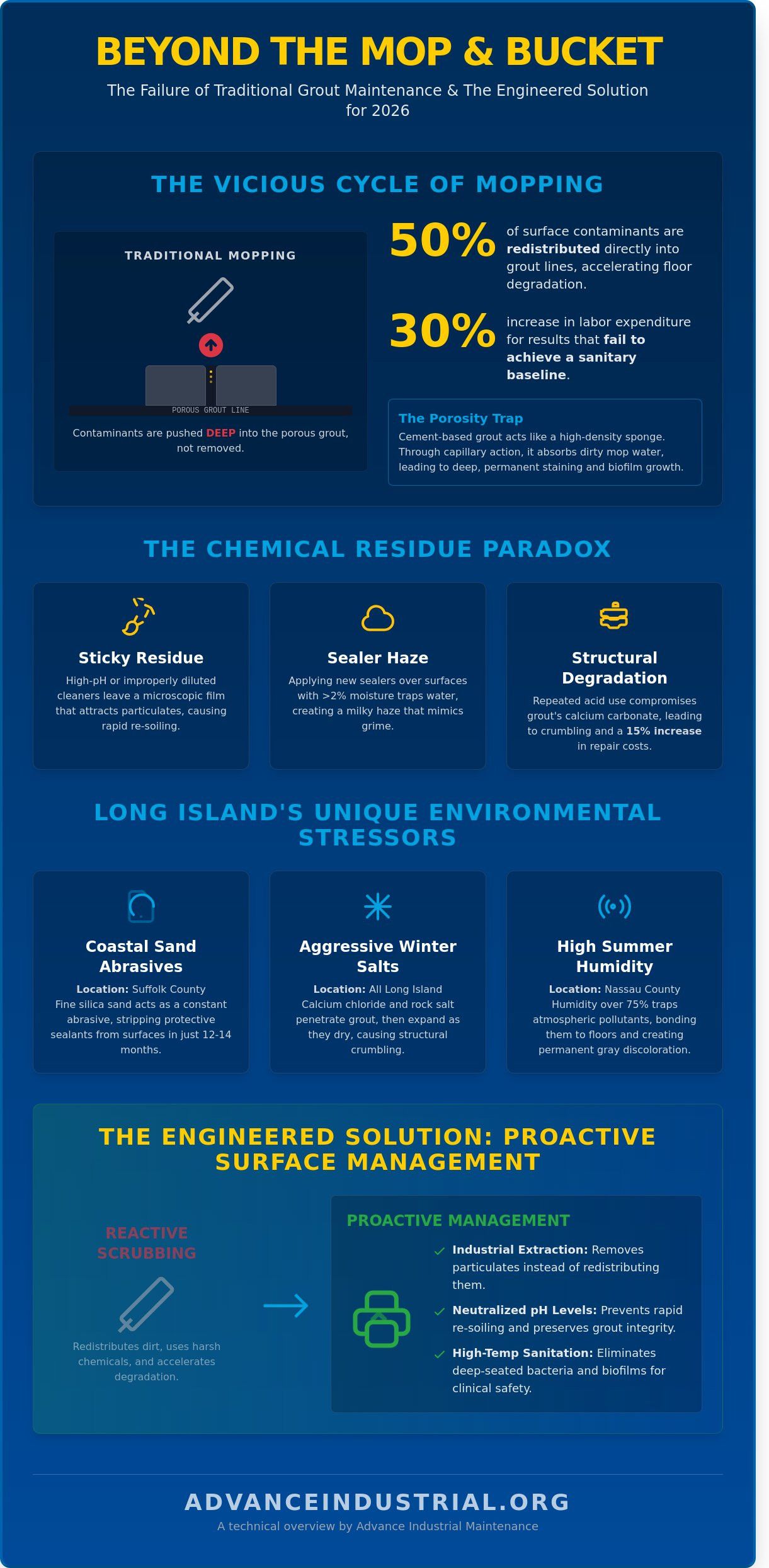
Traditional mopping procedures often redistribute up to 50% of surface contaminants directly into porous grout lines, effectively accelerating the degradation of your facility's flooring. For facility managers across Nassau and Suffolk Counties, these persistent grout cleaning challenges result in a 30% increase in labor expenditure without achieving a sanitary baseline. You understand that daily maintenance should yield a clean environment, yet discoloration and biofilm continue to compromise your operational standards and slip-resistance ratings.
This article explains why standard cleaning agents fail to maintain commercial grout and how you can implement engineered maintenance protocols for 2026. We'll provide the technical insights needed to eliminate persistent maintenance hurdles while reducing long-term MRO costs. We will examine the transition from reactive scrubbing to proactive surface management to ensure your facility maintains its structural integrity and safety compliance. By prioritizing technical authority over marketing hype, you can secure the uninterrupted productivity your operation requires.
Key Takeaways
- Understand why traditional mopping fails to address deep-seated contaminants and how aggressive chemicals can compromise grout integrity.
- Identify the specific environmental factors in Nassau and Suffolk Counties, such as abrasive coastal sand and winter calcium chloride, that accelerate surface degradation.
- Learn how to navigate complex grout cleaning challenges by implementing industrial-grade extraction systems that remove particulates rather than redistributing them.
- Discover the technical necessity of neutralizing chemical pH levels to prevent rapid re-soiling and maintain the long-term durability of your facility’s flooring.
- Adopt a strategic maintenance framework engineered to preserve critical infrastructure and ensure uninterrupted productivity across commercial environments.
Myth-Busting the "Mop and Bucket" Approach to Grout
Standard maintenance protocols often rely on traditional mopping, yet this method frequently exacerbates the very grout cleaning challenges it intends to solve. In high-volume industrial environments across Melville and Hauppauge, surface-level agitation fails to reach the core of the substrate. This results in a cycle where cleaning water becomes a transport mechanism for contaminants rather than a removal tool.
The Porosity Trap: Why Grout Isn’t Just "Dirty Tile"
Industrial flooring systems typically pair non-porous ceramic or porcelain with cementitious grout. While the tile remains impervious, the porous nature of cement-based grout allows it to function like a high-density sponge. Through capillary action, dirty mop water is absorbed deep into the grout's internal structure. Grout porosity is a structural vulnerability in high-traffic commercial zones. This vulnerability is why daily mopping in a 50,000-square-foot distribution center often leads to permanent subsurface staining within 12 months of installation, eventually impacting operational uptime.
The Chemical Residue Paradox
Facility managers often turn to aggressive bleach or acidic cleaners as part of their standard MRO supplies strategy. This is a tactical error. High-pH cleaners leave a microscopically sticky film that attracts particulates, creating a rapid re-soiling effect. This chemical residue paradox is a common driver of grout cleaning challenges in Long Island's medical and food processing sectors.
- Residue Accumulation: Improper chemical ratios, specifically exceeding a 1:10 dilution standard, lead to accelerated wear on industrial floor plates.
- Sealer Haze: Discoloration isn't always dirt; applying new sealers over 2% moisture-laden surfaces creates a milky haze that mimics grime.
- Structural Degradation: Repeated acid use compromises the calcium carbonate within the grout, leading to crumbling and 15% higher repair costs over a three-year cycle.
Relying on manual mopping for industrial-grade floors is an outdated strategy for 2026. Precision cleaning requires mechanical extraction that bypasses the capillary trap entirely to ensure long-term structural integrity.
Technical Grout Challenges Specific to Long Island Facilities
Long Island facilities face environmental stressors that accelerate floor degradation and complicate maintenance schedules. In Suffolk County, fine silica sand from coastal environments acts as a constant abrasive, stripping protective sealants from tile surfaces within 12 to 14 months. This particulate matter creates significant grout cleaning challenges for high-traffic commercial spaces. During winter months, the heavy application of calcium chloride and rock salt introduces aggressive minerals that penetrate the grout's porous structure. These salts expand as they dry; this process causes sub-florescence, which leads to structural crumbling and a total loss of grout integrity. Nassau County facilities experience a distinct graying effect in office lobbies, driven by summer humidity levels that frequently surpassed 75% in July 2024. This moisture traps atmospheric pollutants and bonds them to the substrate, creating a permanent discoloration that standard mop-and-bucket methods cannot resolve.
Efflorescence vs. Sealer Haze: A Professional Diagnosis
Facility managers must distinguish between two common visual failures to apply the correct remediation. Efflorescence occurs when mineral salts migrate to the surface, leaving a white, powdery residue common in New York masonry. In contrast, sealer haze appears as milky, irregular pooling caused by improper application or moisture trapped during the curing process. For Long Island climates, choosing the correct carrier is vital. Solvent-based carriers offer superior penetration in high-moisture coastal zones, while water-based options are often required for VOC compliance in interior office spaces. Accurate diagnosis prevents the common mistake of applying more sealer over salt deposits, which creates a permanent, cloudy barrier.
Biofilm and Sanitation Risks in Healthcare Environments
In healthcare settings, porous grout can become a breeding ground for biofilms and harmful microbes. When moisture levels are not strictly managed, these areas are susceptible to fungal growth that requires specialized intervention. To ensure your facility maintains the highest hygiene standards, check out ABC Mould Cleaning Solutions for expert guidance on professional mould remediation and sanitation protocols.
Engineering a Long-Term Solution for Tile Maintenance
Solving persistent grout cleaning challenges in commercial environments requires a shift from reactive scrubbing to an engineered maintenance framework. Facility managers in Long Island often face porous grout lines that act as magnets for industrial contaminants. A four-step protocol ensures these surfaces remain compliant with safety standards while preserving the underlying substrate.
- Step 1: Industrial Extraction. We utilize truck-mounted systems capable of delivering 1,200 PSI of pressure combined with 200-degree water. This force dislodges deep-seated particulates that standard mopping cannot reach.
- Step 2: pH Neutralization. Chemical residue is a primary cause of rapid re-soiling. We apply neutralizing agents to balance the floor's pH, ensuring the surface doesn't remain tacky and attract new debris.
- Step 3: High-Solids Sealing. Applying a high-solids penetrating sealer creates a hydrophobic barrier. This protection is vital for high-traffic zones where liquid penetration leads to structural degradation.
- Step 4: MRO Integration. Establishing a recurring Maintenance, Repair, and Operations schedule protects your capital investment. Data from 2024 facility audits shows that structured floor MRO can extend tile lifespan by 12 years.
The Single-Source Advantage for Long Island Businesses
A single-source approach to facility maintenance and renovation ensures that every aspect of the building, from the grout lines to the structural walls, is handled with precision. If you are considering expanding your space or requiring high-end renovations, you can find out more about how specialized design-build teams execute room additions and complex structural projects.
Uninterrupted Productivity: Scheduling for Zero Downtime
Maintaining high-traffic areas shouldn't disrupt your workflow. We address grout cleaning challenges by utilizing low-moisture techniques and rapid-dry airmovers. These tools allow active offices to return to full capacity within 60 minutes of service completion. You can learn more about our Tile and Grout Cleaning Expertise to see how we prioritize your facility's productivity and industrial excellence.
Securing Your Facility’s Operational Continuity for 2026
Maintaining industrial floor integrity requires moving beyond outdated maintenance myths. Relying on a standard mop and bucket fails to address the deep-seated grout cleaning challenges common in Nassau and Suffolk County facilities. These traditional methods often push contaminants deeper into porous surfaces rather than removing them. Advance Industrial brings over 40 years of industrial maintenance experience to every project, utilizing specialized equipment engineered for high-capacity commercial tile restoration. Our local Long Island staff is trained in healthcare-grade sanitation standards to ensure your facility meets the rigorous demands of 2026 and beyond. We prioritize technical precision to eliminate downtime and protect your infrastructure. By implementing an engineered solution, you secure a predictable maintenance cycle that supports uninterrupted productivity and industrial excellence. It's time to transition from reactive cleaning to a strategic partnership that values durability and technical authority. We understand the high stakes of facility management and provide the stability your operation requires.
We're ready to help you optimize your facility's performance today.
Frequently Asked Questions
Why does my grout look dark even after it has been professionally cleaned?
Permanent staining occurs when liquid contaminants penetrate the porous structure of unsealed grout. If the material remains dark after a professional extraction process, the pigments have bonded with the cementitious substrate at a molecular level. This is one of the primary grout cleaning challenges in high-traffic Long Island facilities where grease and chemical spills are frequent. According to Tile Council of North America (TCNA) standards, once a stain reaches the substrate, standard surface cleaning won't reverse the discoloration.
Is it possible to change the color of my commercial grout without replacing the tile?
You can change the color of your grout using industrial-grade color sealers or engineered epoxy coatings. These solutions provide a consistent aesthetic while creating a non-porous barrier that prevents future liquid penetration. This process eliminates the 100% replacement cost of a full tile tear-out. In a 2023 industrial maintenance study, color sealing was found to reduce ongoing maintenance labor by 25% because it simplifies the soil removal process and protects the grout cleaning challenges found in commercial environments.
How often should a commercial facility in Long Island have its grout professionally sealed?
Commercial facilities in Long Island should schedule professional grout sealing every 12 to 18 months to maintain structural integrity. High-moisture environments or 24/7 operations require a more aggressive 6-month inspection cycle to prevent seal failure. Maintaining this schedule ensures operational uptime by preventing water infiltration into the subfloor. Data from the National Floor Safety Institute indicates that properly sealed floors maintain a higher coefficient of friction, reducing slip and fall risks by 30% over a 5-year period.
What is the white powdery substance appearing on my new tile floor grout?
The white powder is efflorescence, which occurs when soluble salts migrate to the surface during the evaporation of moisture. This typically happens within the first 60 days of a new installation as the mortar bed cures. You can remove these deposits using a pH-neutral cleaner or a specialized acidic solution designed for masonry. Failure to address this can lead to 15% faster grout degradation if the mineral buildup isn't managed through a consistent MRO supply protocol.